The thread · topic 9/22 · 1453
The Fall of Constantinople in 1453 and Its Consequences
29 May 1453: Mehmed II takes Constantinople. The siege, the stakes, then what followed: a tolled Bosphorus, a Europe seeking a way round, contested straits.
Contents
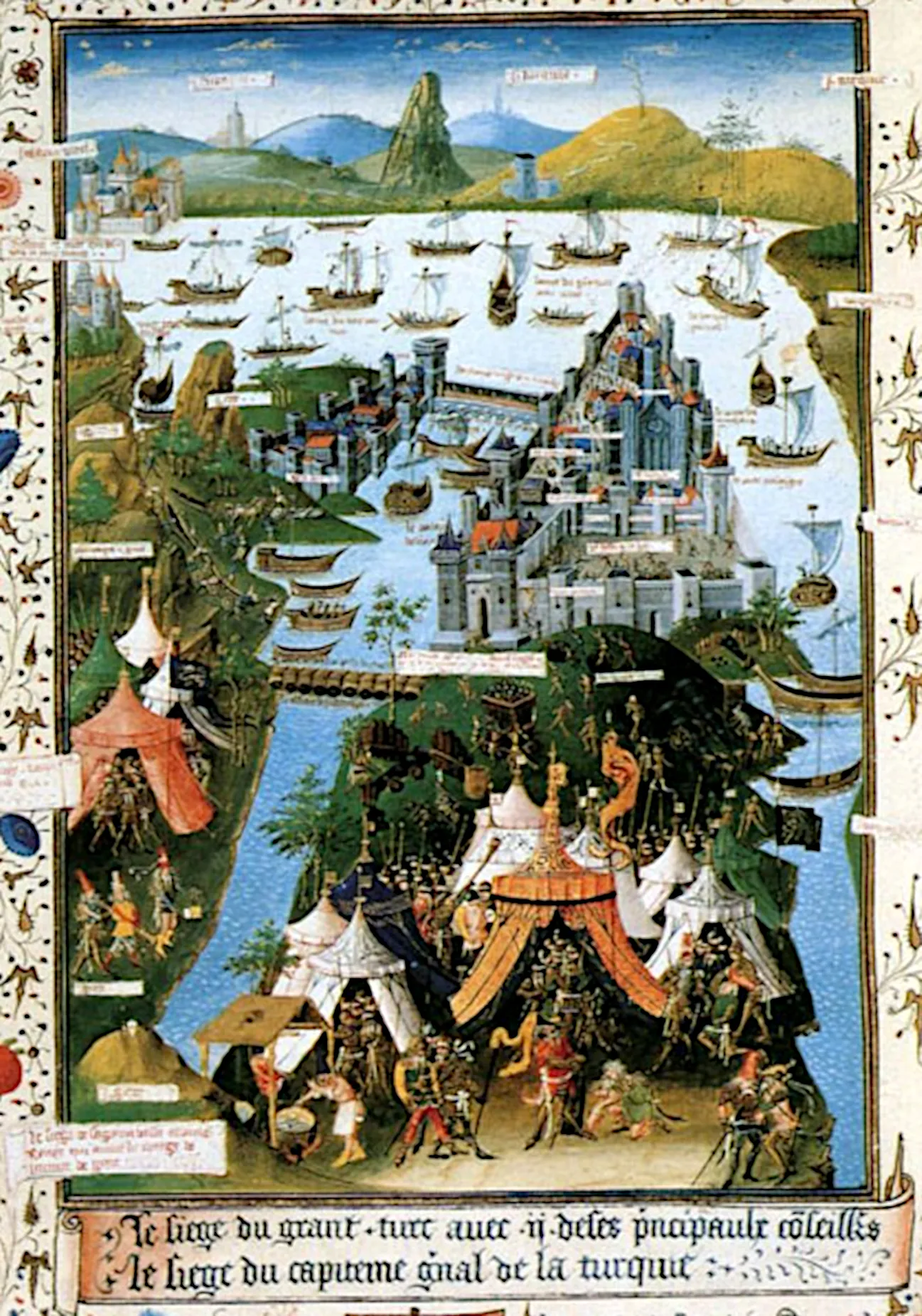
On the morning of Tuesday 29 May 1453, after nearly two months of siege, the soldiers of Sultan Mehmed II broke through the walls of Constantinople.[1] Somewhere in the fighting the last Byzantine emperor, Constantine XI, vanished, and with him an empire that had called itself Roman for more than a thousand years. The city had fallen; its story was only beginning. In changing hands, Constantinople also changed the fate of a passage between two seas, and Europe would spend centuries looking for a way to do without it.
- 1453Constantinople is takenMehmed II seizes the Byzantine capital on 29 May.
- 1454The Bosphorus becomes a toll gateVenice keeps its right to trade, for a tax of 2 per cent on its sales.
- 1475The Black Sea closesCaffa, the Genoese trading post in Crimea, falls to the Ottomans.
- 1478The East grows dearerThe peace costs Venice 10,000 ducats a year for the right to trade.
- 1923The end of a capitalAfter nearly five centuries, Istanbul ceases to be an imperial capital.
- 1936The straits by treatyThe Montreux Convention sets the rules of passage, still in force.
- 2022Montreux in wartimeAnkara bars the straits to the belligerents' warships.
April–May 1453
Fifty days before the walls
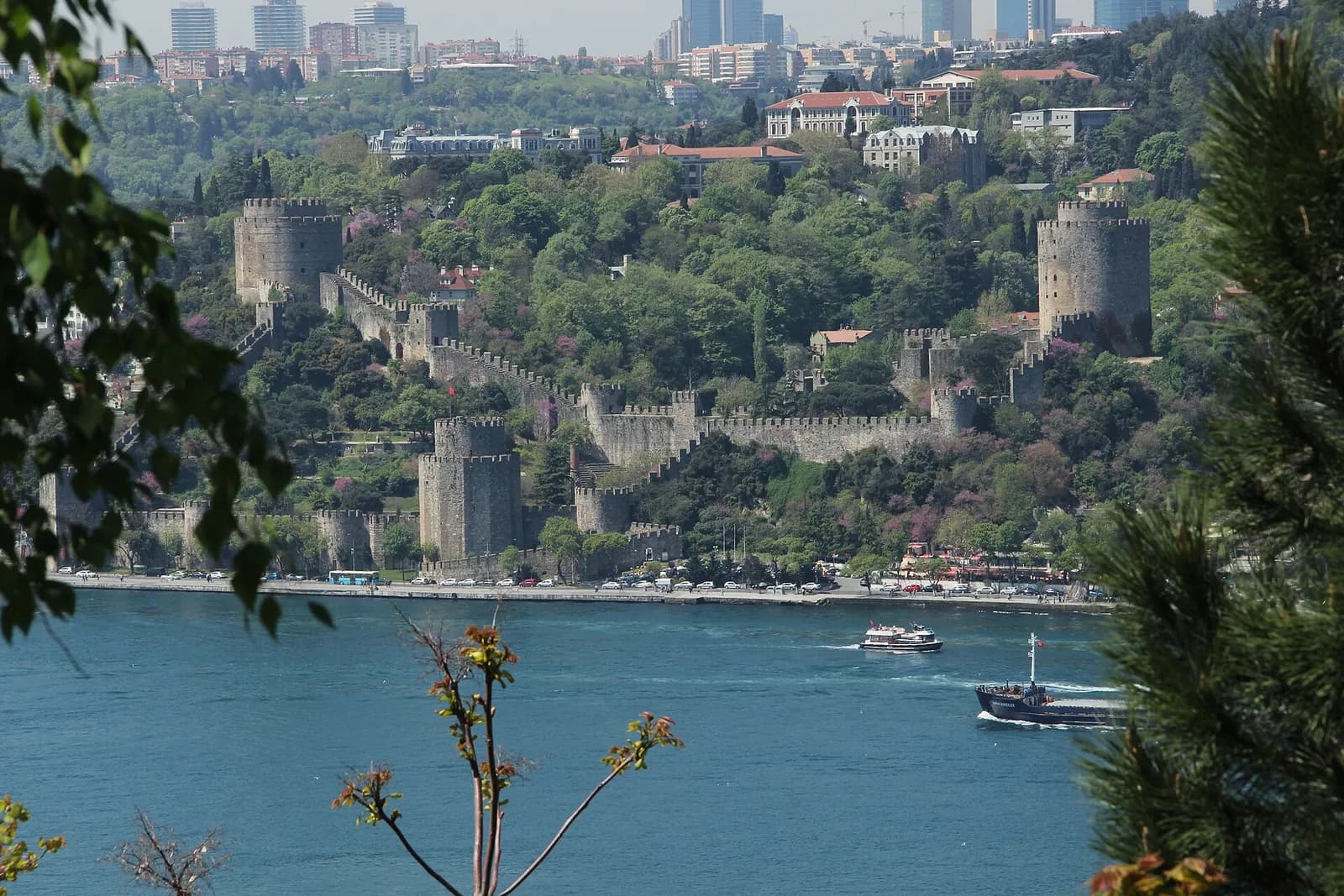
The work started well before the guns opened fire. On the European shore of the Bosphorus, Mehmed II raised the fortress of Rumeli Hisar, facing Anadolu Hisar on the Asian side.[2] The order he gave its commander, as the Byzantine chronicler Doukas reports it, left no room for doubt: “Do not allow ships sailing from the Hellespont to the Black Sea or from the Black Sea to the Hellespont, no matter under whose flag they may be sailing.”[3] The strait had its gatekeeper before the city had its siege.
On 5 April 1453, an hour after daybreak, the Ottoman army drew up before the city. The Venetian Nicolò Barbaro, shut up inside Constantinople, put it at some 160,000 men;[4] George Sphrantzes, a confidant of the emperor, spoke of 200,000 men and 400 ships.[1] Chroniclers thought big. Historians today prefer a figure of 60,000 to 80,000 men, which was still overwhelming.[5]
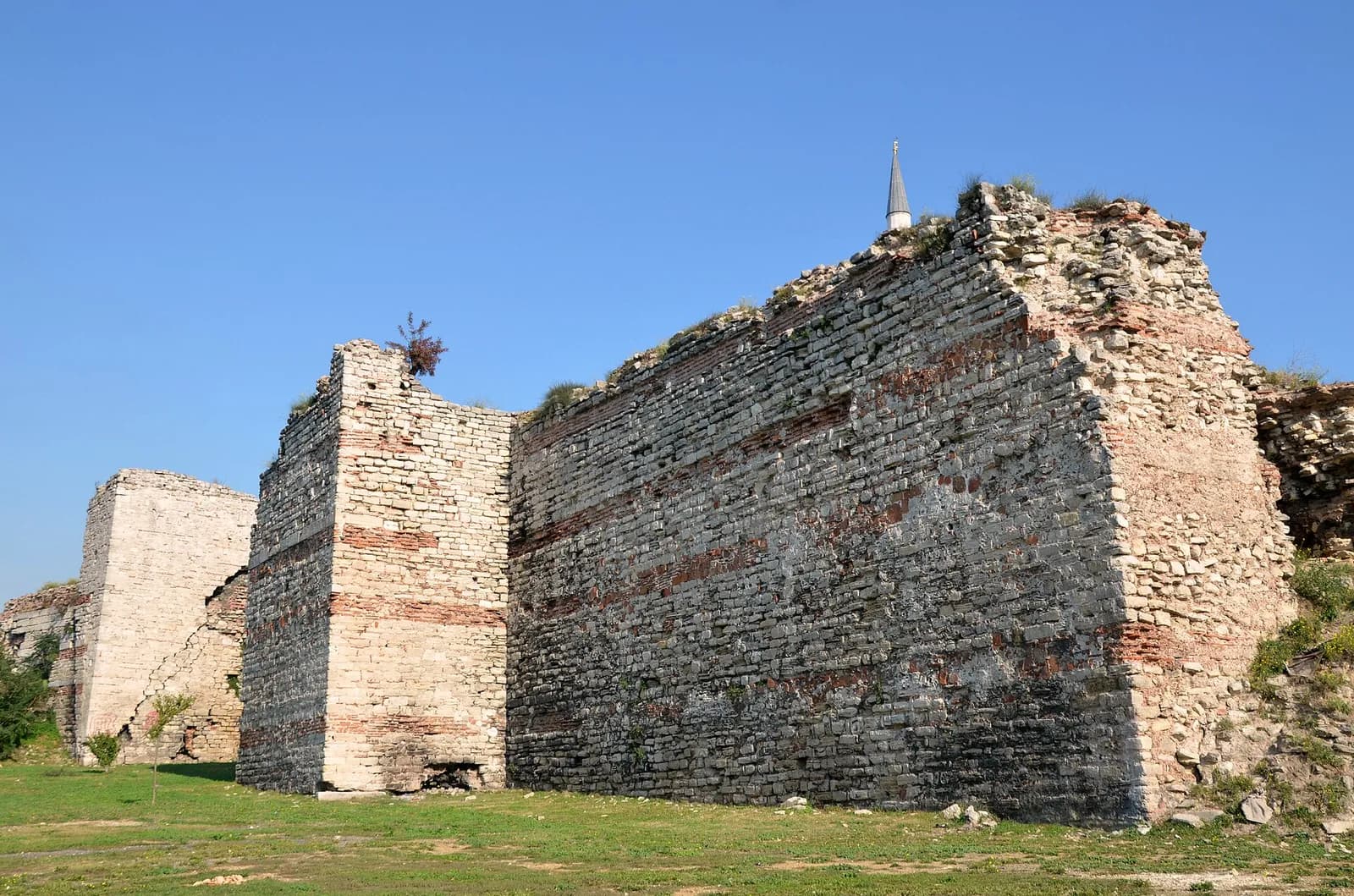
Behind the walls, the count did not take long. “Our defenders amounted to 4,773 Greeks,” Sphrantzes wrote, “as well as just about 200 foreigners.”[1] Doukas put the men under arms at 8,000 at most.[3] The city counted on two defences: its land walls, built in 412–414 under Theodosius II,[6] and a chain stretched across the Golden Horn, its harbour, to Galata on the far shore.[3]
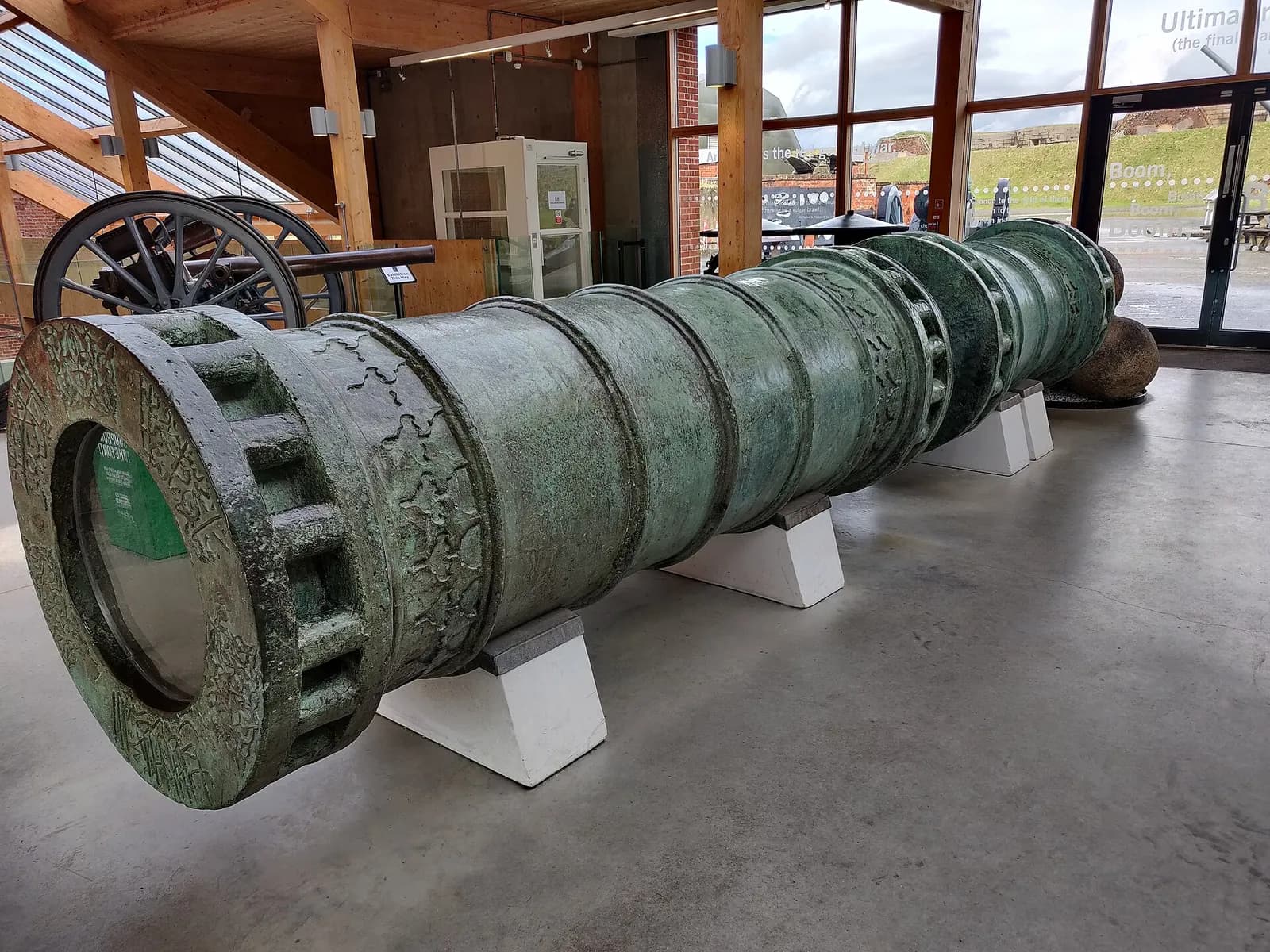
Against those walls Mehmed brought a new kind of weapon. Doukas tells its origin as a matter of pay. A Hungarian founder had first offered his services to the emperor, who paid him poorly. He went over to the sultan, and within three months his moulds had produced what Doukas calls “a terrifying and extraordinary monster”.[3] The Greek historian Kritovoulos describes a mould forty spans long and 1,500 talents of bronze and tin, “as was reported”.[7] Barbaro notes that one of the guns trained on the gate of St Romanus threw balls of about 1,200 Venetian pounds.[4] Mehmed later had other giant pieces cast. One of them, the work of the founder Munir Ali, made in two parts that screw together, is now in England.[8]
A historians' debate: did the cannon take the city?
To hear Kritovoulos tell it, “both the inner wall and the outer one had been wrecked to the ground by the cannon”.[7] Modern historians are more careful. Kelly DeVries argues that the great bombard may have done no decisive damage to the land walls, and that the mortars firing on the harbour area were what stretched the defence to breaking point; Marios Philippides and Walter Hanak think it fell short of what was expected of it against the walls.[9] Even its fate is disputed. Doukas has it still in use later in the siege, while other writers say it cracked on the second day.[3]
That left the harbour chain, which kept the Ottoman fleet out of the Golden Horn. Mehmed got round it in a way nobody expected: overland. On the hill above Galata his men laid slipways covered with timber, about eight stades long, and hauled ships along them into the harbour.[7] Seventy-two of them according to Barbaro, eighty according to Doukas: fustas and biremes, light enough to be dragged over a hill.[4][3] The defenders now had the enemy behind the very chain that was meant to protect them.
The final assault came on 29 May. The fighting lasted “from dawn until noon”, Barbaro writes.[4] On the walls the Genoese Giovanni Giustiniani, who had come from Genoa with two great ships and his own soldiers and whom the emperor had made protostrator, went down wounded. Kritovoulos says a crossbow bolt struck him in the chest; Doukas, that a lead shot passed through his arm.[7][3] Barbaro, no friend of the Genoese, accuses him of deserting his post and running for his ship.[4]
And the emperor? The witnesses do not agree. Kritovoulos has him fall “in gallant combat”; Doukas says he was cut down like a common soldier by men who did not know who he was; Barbaro passes on a rumour that he had hanged himself.[7][3][4] Only one thing is certain. Constantine XI did not outlive his city.
What the sources do not say
A long chronicle attributed to Sphrantzes, complete with a last speech by Constantine XI, has fed many retellings. In 1934 J. B. Falier-Papadopoulos showed that it was not his work: only the short chronicle is genuine, and the long one was put together later.[10] As for the Kerkoporta, the small gate supposedly left open for the Turks to come through, it rests on Doukas's account alone, and historians have declined to settle the question.[3][9]
330–1453
The end of an empire, the key to two seas
More than a city fell that day. Dedicated on 11 May 330, Constantinople had been for over eleven centuries the capital of a Christian empire that saw itself as the heir of Rome.[11] With it went the Byzantine Empire.
For Mehmed II the city was a capital, but above all it was a key. Whoever held Constantinople held the passage between the Black Sea and the Mediterranean. In the words of the historian Albert Lybyer, the capture of 1453 gave the sultan “complete control of the Straits and a commanding position towards Genoa and Venice”.[12] Turning the Byzantine city into an Ottoman capital would take several more decades.[2]
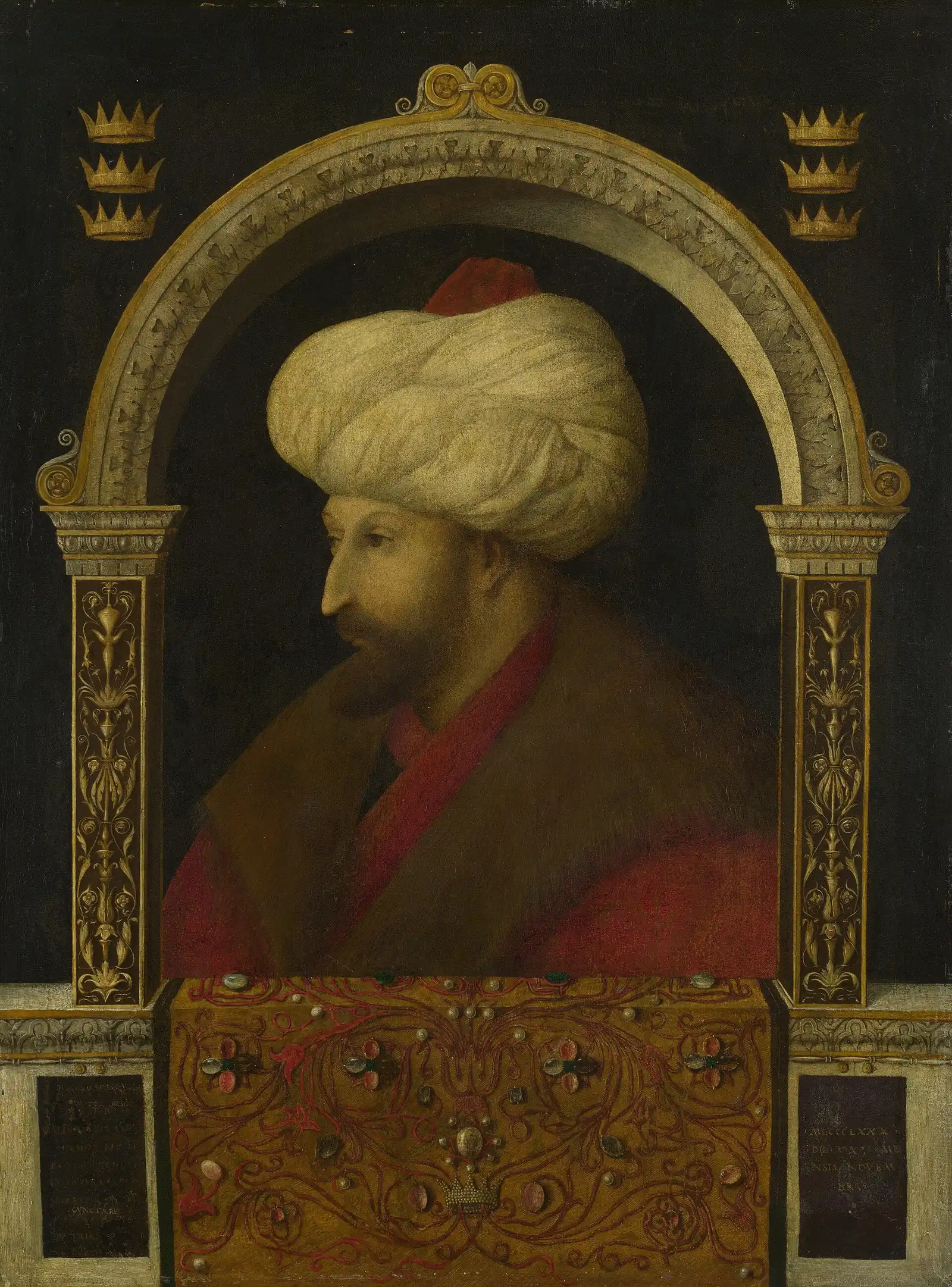
Textbooks would later make the date the end of the Middle Ages. That is a convention, popularised in 1688 by Cellarius's school textbook, whose title ran the period a temporibus Constantini magni ad Constantinopolim a Turcis captam: from Constantine the Great to the capture of Constantinople by the Turks.[13] French universities, for their part, date the start of the modern era to 1492.[14]
Another picture dies hard: Greek scholars fleeing the city with manuscripts under their arms, off to light the Italian Renaissance. The traffic had started long before. Manuel Chrysoloras was teaching Greek in Florence from 1397, and Bessarion reached Italy in 1437 with the Byzantine delegation to the Council of Ferrara-Florence.[15][16] After 1453 Bessarion made himself the keeper of the Greek inheritance: the books he gave around 1468 formed the first nucleus of the Marciana library in Venice.[16] The fall amplified a movement. It did not start one.
1453–1475
The Bosphorus becomes a toll gate
The new master of the straits had no intention of shutting up shop. On 1 June 1453 Galata, the Genoese colony across the water, surrendered in return for a guarantee of lives and property. It lost its autonomy, but Mehmed was keen that it should remain a busy trading port.[17]
Venice, which carried most of the trade from the East into Europe, opened talks at once.[12] The treaty of 18 April 1454 guaranteed the Venetians freedom to trade throughout the sultan's lands, by sea and by land, in return for a tax of 2 per cent on their sales; the same rule applied to the sultan's merchants in Venice.[18] The trading privileges of Genoa and Venice were, in Lybyer's phrase, “renewed with little change”.[12] The passage stayed open. It simply had a gatekeeper now, and the gatekeeper collected.
Further north, a door was slowly swinging shut. Little by little the Black Sea closed to Italian ships.[19] Caffa, the great Genoese trading post in Crimea, was besieged as early as 1454; crushed by the tribute imposed on it, it fell to the Ottomans in 1475.[20] Lybyer adds a caveat: the trade to the East through that sea “was already practically gone”.[12]
In Europe the news raised the alarm, and it travelled by a very new medium: print. Between 6 and 24 December 1454 a workshop in Mainz printed a small calendar, known today as the Türkenkalender, which the Bavarian State Library attributes to Gutenberg.[21] Month by month, its twelve poems urge the rulers of Europe to act against the Turks.[22] The copy that survives is in Munich.[21]
1478–1517
Getting round the gatekeepers of the East
Over the years the toll grew heavier. In 1478 Venice signed a peace treaty with the sultan that repeated almost word for word those of 1446 and 1454, but now charged it 10,000 ducats a year for its trading privileges, plus 100,000 ducats to be paid within two years.[23]
One idea long held the field. The Ottomans, it ran, had blocked the spice route, and Europe, starved of pepper, had taken to the ocean to find another. In 1882 the English economist James Thorold Rogers set it down in plain terms: “The fall of Constantinople, beyond doubt, stimulated research into the unknown oceans of the west and south.”[24] It makes a good story. Historians have since hedged it about with qualifications.
A historians' debate: was there a spice blockade?
In 1915 Albert Lybyer objected that spices then came through Mamluk Syria and Egypt, which lay beyond Ottoman reach until 1516 and 1517. Had the fall of Constantinople closed the routes, he argued, “the price of spices must have shown a marked increase between 1453 and 1498, which it did not do”.[12] Frederic Lane confirmed the point in 1968 with Venetian prices: pepper fell there around 1432 and stayed low until the Venetian–Ottoman war of 1499.[25] Kevin O'Rourke and Jeffrey Williamson add a qualification. Once inflation is taken out, pepper prices rise from 1450 onwards in England, Belgium, the Netherlands and Austria, which made a direct route ever more tempting.[26]
Average price of pepper in England in the fifteenth century, by decade (shillings per dozen pounds)
| decade | shillings |
|---|---|
| 1401-10 | 12 |
| 1411-20 | 32 |
| 1421-30 | 16 |
| 1431-40 | 13 |
| 1441-50 | 9 |
| 1451-60 | 13 |
| 1461-70 | 14 |
| 1471-80 | 14 |
| 1481-90 | 17 |
| 1491-1500 | 17 |
Above all, the Portuguese push had not waited for 1453. Ceuta was taken in 1415, Madeira settled in 1419–1420, the Azores in 1439.[26] In 1434 Gil Eannes rounded Cape Bojador, and on 18 February 1453, three months before Constantinople fell, the chronicler Zurara finished his account of the discoveries of Henry the Navigator.[27]
What the sources do support is subtler. The Atlantic powers wanted to get round every middleman in the eastern trade. In the fifteenth century, Lybyer recalls, “the Mameluke sultan and his subjects took toll of all, and Venice did most of the carrying and gained most of the profit”.[12] By holding the straits and taxing Venetian merchants, the Ottomans added their name to the list of gatekeepers. The fall of 1453 did not start the race for the ocean; it gave the race one more reason. Two voyages would come of it, each of which we tell in its own article: Columbus's to the west, and Vasco da Gama's to India.
And the Ottomans? When they conquered Egypt in 1516 and 1517, they made no attempt to strangle the spice trade. They tried instead to increase its volume, for the revenue it brought.[28]
1774–2022
The straits, from Mehmed II to the war in Ukraine
To see what Mehmed II won in 1453, a map is enough. By taking Constantinople the Ottomans held the Bosphorus and, with the Dardanelles already in Turkish hands, the whole waterway from the Black Sea to the Aegean.[29] Once Crimea had been conquered, the Black Sea became what the historian Ahmed Şükrü Esmer calls a “Turkish lake”, closed to foreign shipping, and so it remained until the Treaty of Küçük Kaynarca in 1774.[29]
With that treaty began a problem that Europe never managed to solve: the question of the Straits.[30] In 1947 Esmer wrote that it had been “the basis of Turkey's relations with the Powers for almost two centuries”.[29] It even outlived the Ottoman Empire. In 1946 and 1947 Soviet pressure for bases and transit rights in the straits was among the reasons for the Truman Doctrine.[31]
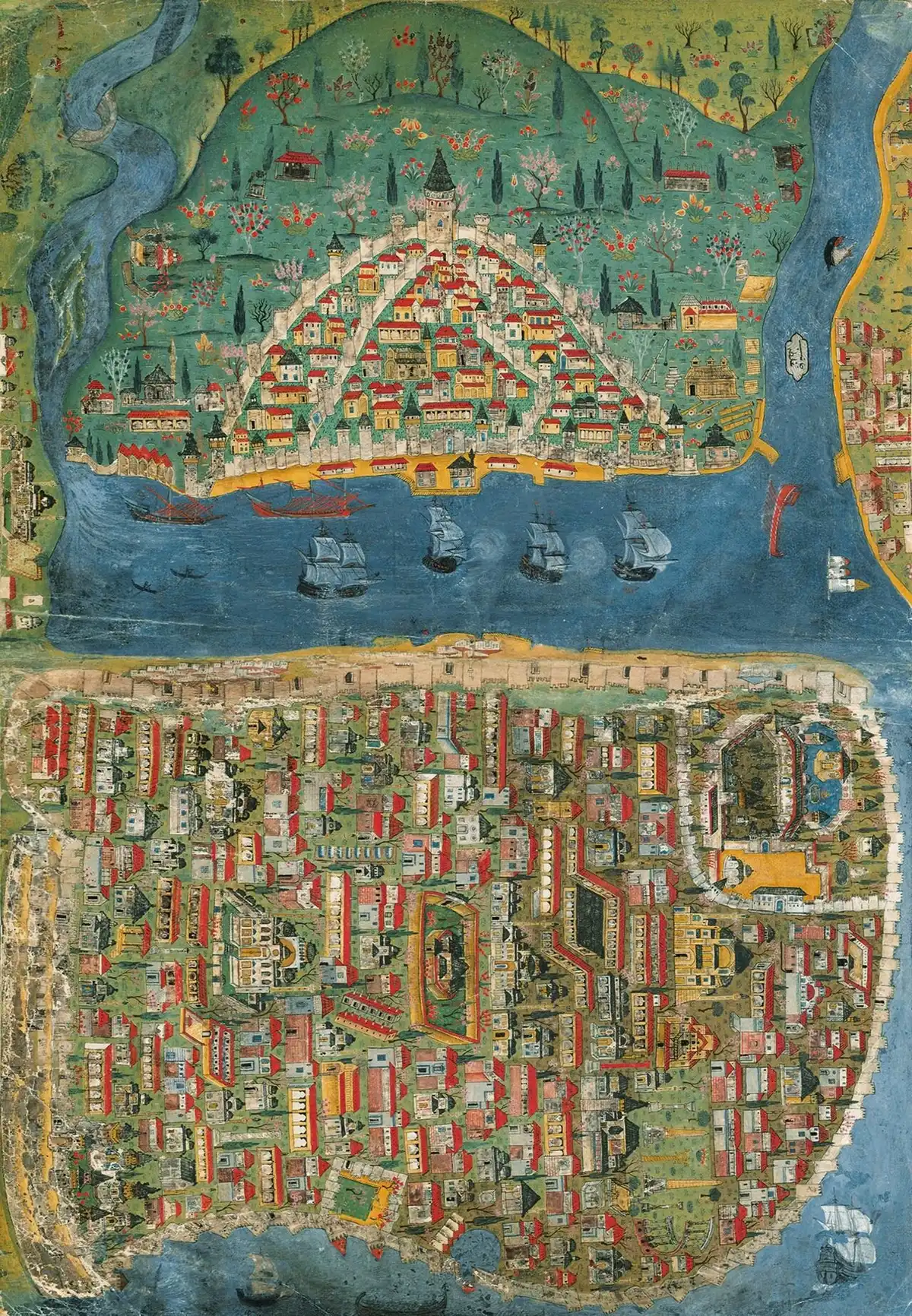
The city itself remained the heart of an empire for nearly five centuries. Mehmed II repopulated it, not least by forcibly settling people there from all over the empire,[32] and at once turned Hagia Sophia into a mosque.[33] Not until 13 October 1923 did a law of a single article make Ankara the capital of Turkey.[34] Hagia Sophia, a museum from 1934, changed status once again in 2020, a decision UNESCO said it “deeply regrets”.[33][35]
The passage, for its part, has been governed since 20 July 1936 by the Montreux Convention. In peacetime it gives merchant vessels “complete freedom of transit and navigation in the Straits, by day and by night, under any flag”,[36] while warships remain bound by precise limits. Ankara describes it as “one of the rare multi-lateral agreements still in force since it was signed”.[37]
In 2022 the old treaty returned to centre stage. On 27 February, a few days after Russia invaded Ukraine, the Turkish foreign minister called the situation a “war” and announced that Turkey would apply the convention.[38] The next day he said he had warned every country, whether it bordered the Black Sea or not, against sending warships through the straits; ships returning to their bases in the Black Sea could still pass, as the text provides.[39][36] More than five centuries after Mehmed II, which warships may pass is still decided on the shores of the Bosphorus.
The strait that Mehmed locked with two fortresses now sees more than 41,000 ships a year, about 113 a day, according to the Turkish Ministry of Transport.[40] In 1936 the figure was 17 a day.[37]
Moscow, the “Third Rome”? A disputed inheritance
In 1472 Ivan III, Grand Prince of Moscow, married Sophia Palaiologina, a niece of Constantine XI.[41] Around 1523–1524 the monk Filofei of Pskov wrote that “two Romes have fallen, and a third stands, and a fourth there shall not be”.[42] The historian Marshall Poe points out, however, that Muscovite rulers ignored the formula in the sixteenth century, and that it was nineteenth-century historians who turned it into an imperial ideology. Other scholars see in it, on the contrary, “a kind of quintessence of ‘Russianness’”.[42][43]
The next link
The Ottomans now held the door to the East, and every passage through it had to be paid for. Before long a navigator would propose avoiding it altogether, by sailing west across the ocean. His name was Christopher Columbus, and his voyage, which we will tell in its own article, is the next link in the chain.
Further reading
- The Fall of Constantinople, 1453 — Steven Runciman (Cambridge University Press, 1965)
The classic narrative of the siege by a great Cambridge Byzantinist, and still a vivid read.
- Constantinople: The Last Great Siege, 1453 — Roger Crowley (Faber & Faber, 2005; published in the US as 1453 by Hyperion)
A brisk modern telling of the siege for the general reader, built on the eyewitness chronicles.
- The Ottoman Empire: The Classical Age, 1300-1600 — Halil İnalcık (Weidenfeld & Nicolson, 1973)
The standard account of how the conquerors of 1453 built and ran their state, by the leading Turkish historian of the empire.
- The Mediterranean and the Mediterranean World in the Age of Philip II — Fernand Braudel, trans. Siân Reynolds (Collins, 1972; University of California Press)
For how the Mediterranean lived through the shift of trade towards the Atlantic.
Sources
- George Sphrantzes, Chronicon Minus, English trans. M. Philippides, 1980; De Re Militari
- Patricia Blessing, Creating an Ottoman Capital: Istanbul in the Late Fifteenth Century, Society of Architectural Historians, 2016
- Doukas, Decline and Fall of Byzantium to the Ottoman Turks, trans. and annotated by H. J. Magoulias, Wayne State University Press, 1975
- Nicolò Barbaro, Diary of the Siege of Constantinople, 1453, English trans. J. R. Melville-Jones, 1969; De Re Militari
- Mark Cartwright, 1453: The Fall of Constantinople, World History Encyclopedia, 2018 (overview)
- Jona Lendering, Constantinople, Theodosian Walls, Livius.org
- Kritovoulos of Imbros, History of Mehmed the Conqueror, English trans. C. T. Riggs, Princeton University Press, 1954; De Re Militari
- Royal Armouries, Voice of the Guns gallery, Fort Nelson
- Michael Angold, Review of M. Philippides and W. K. Hanak, The Siege and the Fall of Constantinople in 1453 (2011), Reviews in History, no. 1101, 2011
- Marios Philippides, The Fall of Constantinople: Bishop Leonard and the Greek Accounts, Greek, Roman and Byzantine Studies, 22/3, 1981
- Ralph W. Mathisen, Constantinople Is Founded, EBSCO Research Starters, 2022
- Albert Howe Lybyer, The Ottoman Turks and the Routes of Oriental Trade, English Historical Review, 30/120, 1915
- Johan Huizinga, Een schakel in de ontwikkeling van den term Middeleeuwen?, Verzamelde werken, vol. 4 (in Dutch)
- Pierre Savy, L'histoire à la découpe, La Vie des idées, 2014, on J. Le Goff, Faut-il vraiment découper l'histoire en tranches ? (in French)
- University of Pennsylvania Libraries, Transmitting Knowledge; Greek Scholarship Reborn, Making the Renaissance Manuscript exhibition
- Eva Del Soldato, Basilios Bessarion, Stanford Encyclopedia of Philosophy
- Halil İnalcık, Galata, Büyük İstanbul Tarihi (in Turkish)
- Samuele Romanin, Storia documentata di Venezia, vol. IV, Venice, Naratovich, 1856 (in Italian)
- Benjamin Arbel, The Last Decades of Venice's Trade with the Mamluks, Mamluk Studies Review, VIII/2, 2004
- Ihor Stebelsky, Teodosiia, Encyclopedia of Ukraine, Canadian Institute of Ukrainian Studies
- Bayerische Staatsbibliothek, Eyn manung der cristenheit widder die durken [Türkenkalender], BSB incunabula catalogue (BSB-Ink), M-149
- Constantin Ittu, Marginal Notes to a Gutenberg's Incunabulum: The Türkenkalender (1454), Apulum, 60/1, 2023
- Diana Gilliland Wright and Pierre A. MacKay, When the Serenissima and the Gran Turco Made Love: The Peace Treaty of 1478, Studi Veneziani, LIII, 2007
- James E. Thorold Rogers, A History of Agriculture and Prices in England, vol. IV, Oxford, Clarendon Press, 1882
- Frederic C. Lane, Pepper Prices Before Da Gama, Journal of Economic History, 28/4, 1968
- Kevin H. O'Rourke and Jeffrey G. Williamson, Did Vasco da Gama Matter for European Markets?, NBER Working Paper 11884, 2005; Economic History Review, 2009
- C. R. Beazley and E. Prestage, Introduction to Zurara, The Chronicle of the Discovery and Conquest of Guinea, Hakluyt Society, 1896
- Giancarlo Casale, The Ottoman Administration of the Spice Trade in the Sixteenth-Century Red Sea and Persian Gulf, Journal of the Economic and Social History of the Orient, 49/2, 2006
- Ahmed Şükrü Esmer, The Straits: Crux of World Politics, Foreign Affairs, January 1947
- Yılmaz Altuğ, The United States of America's Policies Towards Turkish Straits, Belleten, Turkish Historical Society, 56/215, 1992
- US Department of State, Office of the Historian, The Truman Doctrine, 1947
- Ashmolean Museum, University of Oxford, Mehmed II 'Fatih' (1451-81)
- Dumbarton Oaks, Harvard University, Hagia Sophia Resources
- Turkish Ministry of National Education, Ankara'nın Başkent Olması, in Turkish
- UNESCO, UNESCO statement on Hagia Sophia, Istanbul, 10 July 2020
- Convention Regarding the Regime of the Straits (Montreux), Text of the convention of 20 July 1936, arts 1, 2 and 19, unofficial English text, Centre for International Law, National University of Singapore; authentic French text in League of Nations Treaty Series, vol. 173
- Turkish Ministry of Foreign Affairs, Note on the Turkish Straits
- Ali Murat Alhas, Anadolu Agency, Turkiye set to implement provisions of Montreux Convention, 27 February 2022
- Mümin Altaş, Anadolu Agency, Dışişleri Bakanı Çavuşoğlu: Kıyıdaş olan, olmayan bütün ülkeleri boğazlardan savaş gemisi geçirmemesi konusunda uyardık, 28 February 2022 (in Turkish)
- TRT Haber, from Anadolu Agency and the Turkish Ministry of Transport, İstanbul Boğazı'ndan geçen yıl 41 bin 363 gemi geçti, 6 February 2025 (in Turkish)
- Medieval Russian Princesses project, St Petersburg State University, Sophia (Zoe) Palaiologina
- Marshall Poe, Moscow, the Third Rome: The Origins and Transformations of a 'Pivotal Moment', Jahrbücher für Geschichte Osteuropas, 49, 2001, pp. 412-429
- M. V. Dmitriev, D. M. Bulanin et al., The theory of Moscow as the Third Rome: Texts and contexts, Studia Slavica et Balcanica Petropolitana, 2023/2
This article was prepared with the help of artificial intelligence from verified sources, then reviewed, corrected and approved by the author. Our method.
It is a translation of the original French article.