Special series · The French revolutions · 1/4 · 1789
The French Revolution of 1789: the year the nation took power
1789: crippled by its debt, the French monarchy summons the Estates-General. The Third Estate declares itself the nation, the Bastille falls, privilege ends.
 By Prism of the World
Listen to this article· 17 min · read by a synthetic voice (Google)
Contents
On 20 June 1789, at Versailles, the deputies of the Third Estate find the hall where they sit locked. They make for a real-tennis court close by; Jean-Sylvain Bailly leads the way and, fearing they might be shut out of this one too, sends five or six deputies ahead to hold it.[1][2] There he reads out the oath the deputies swear: never to separate “until the Constitution of the kingdom is established and set on solid foundations”.[3][4][1] Within a few months sovereignty passes from the king to the nation, privileges fall, and a debt that had driven the kingdom to insolvency leads to the sale of the Church's lands. The Declaration adopted that year still has “full constitutional value” in France.[5]
- 1788Empty coffersOn 8 August the king summons the Estates-General for 1 May 1789.
- June 1789The nation declares itselfThe Third Estate becomes the National Assembly and swears to give France a constitution.
- 14 July 1789The BastilleParis arms itself at the Invalides; the fortress surrenders.
- August 1789Privileges abolished, rights declaredThe night of 4 August, then the Declaration of the Rights of Man.
- December 1789The assignatsChurch lands back a paper that will become money.
- 1799“It is over”The Consuls declare the Revolution settled on its principles.
- 1958A written legacyThe 1789 Declaration is named in the preamble to the Constitution.
1786 – 14 July 1789
A kingdom that pays its interest first
In 1789, according to the economists Thomas Sargent and François Velde, servicing the debt takes about 60% of the monarchy's revenue.[6] The weight of the debt itself depends on the calculation: 63% of national product in 1789 for Sargent and Velde; 56% of GDP in 1788 for David Weir, quoted by the historian Eugene White, against 182% in Great Britain.[6][7] The difference lies elsewhere: financing its debt costs France 7.5% and its neighbour 3.8%.[7] The American war, according to a report presented to the Assembly in 1791, left the kingdom “a new debt of 733 million”, contracted between 1777 and 1783.[8]
By 1786 the deficit has reached one sixth of the royal budget.[9] On 22 February 1787 the minister Calonne proposes to an assembly of notables a uniform tax across the kingdom.[9] To the objections he replies that “the right to consent to taxation is not the right to refuse it”.[7] The Parlement of Paris holds that no new permanent tax can be decreed without the Estates-General, which have not met since 1614. In 1788 the debt swallows the greater part of the king's revenue.[7] On 8 August Louis XVI summons the Estates-General for 1 May 1789.[10]
Then the weather takes a hand. On 13 July 1788 an exceptionally violent storm sweeps the country from Poitou to the north; hail flattens the crops, and the price of wheat climbs in the months that follow.[11] In Paris, from February to the end of July 1789, the magistrates fix the four-pound loaf at an unvarying 14½ sous.[12] On 10 June the English traveller Arthur Young notes that the scarcity is terrible: a pound of the coarse brown bread the poor live on costs three and a half to four sous.[13]
Did dear bread make the Revolution? The historian George Rudé pointed out that the Bastille fell on the very day the price of grain reached its peak across France; Donald Sutherland sees only a coincidence, with no link to the fortress's surrender.[12] Young, for his part, settles the matter as a traveller would, at Nancy on 15 July: the deficit, he writes, would not have produced a revolution without the high price of bread.[13]
The Third Estate declares itself the nation
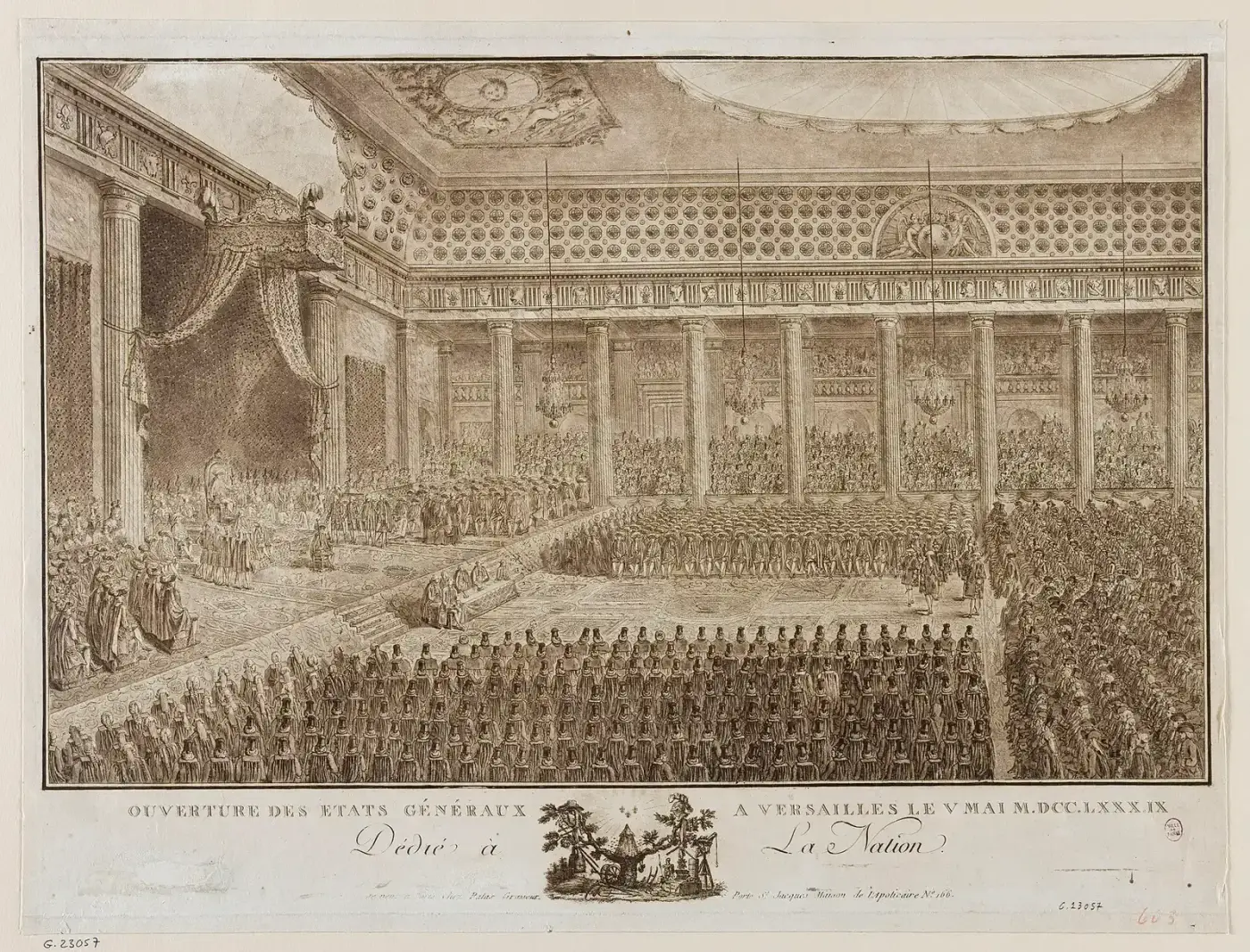
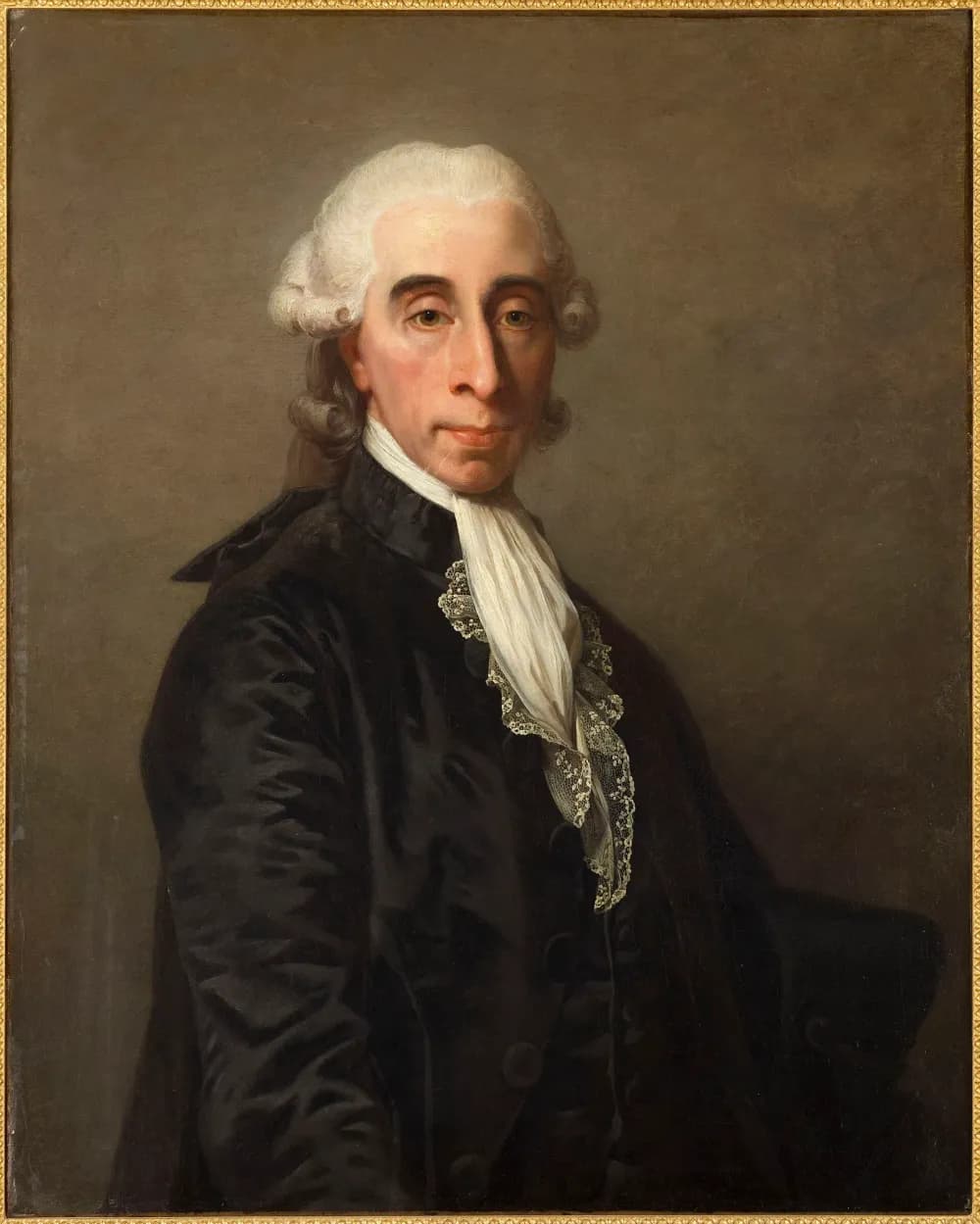
The Estates-General open on 5 May 1789 at Versailles, in the Salle des Menus-Plaisirs. The clergy, the nobility and the Third Estate sit in separate chambers.[14][1] The historian Yves Durand counts 661 deputies for the Third Estate, 326 for the clergy and 330 for the nobility; other tallies give slightly different totals.[15] The Third Estate is thus roughly as numerous as the other two orders combined; but as long as each order deliberates apart, it carries only one chamber in three.
On 17 June Sieyès's motion carries by 491 votes to 90: the Third Estate constitutes itself the National Assembly and, in its first decree, provisionally authorises the collection of taxes and the servicing of the public debt.[14] The debt that had brought the Estates-General together becomes the nation's business.
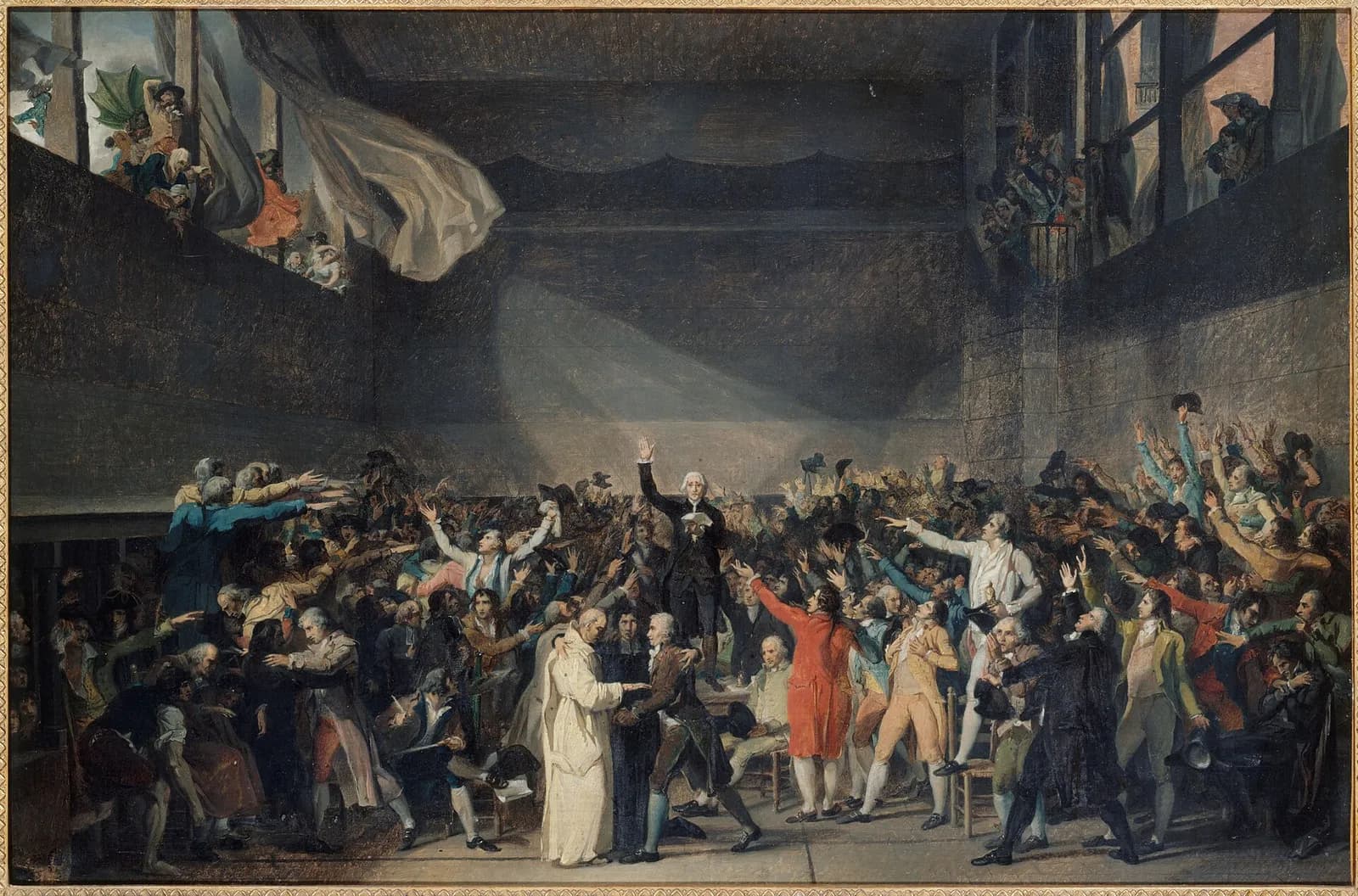
Three days later comes the scene at the tennis court. The resolution the deputies adopt there lays down a principle that changes everything: “wherever its members are gathered, there is the National Assembly”.[4] It no longer depends on a hall that can be locked against it.
“Nothing”, 14 July
On 11 July Louis XVI dismisses his minister Necker. In the journal where he records his hunts and ceremonies he writes: “Saturday 11. Nothing. Departure of M. Necker.”[16] In Paris the news sets off numerous demonstrations.[17] On the 12th, at the Palais-Royal, Camille Desmoulins tears a leaf from a tree, proposes wearing it as a patriotic badge and calls for insurrection.[18] The gardens have been seething for weeks. On 9 June Young counted thirteen pamphlets published that day and ninety-two the previous week, and orators who, standing on a table or a chair, harangued the crowds in the cafés.[13]
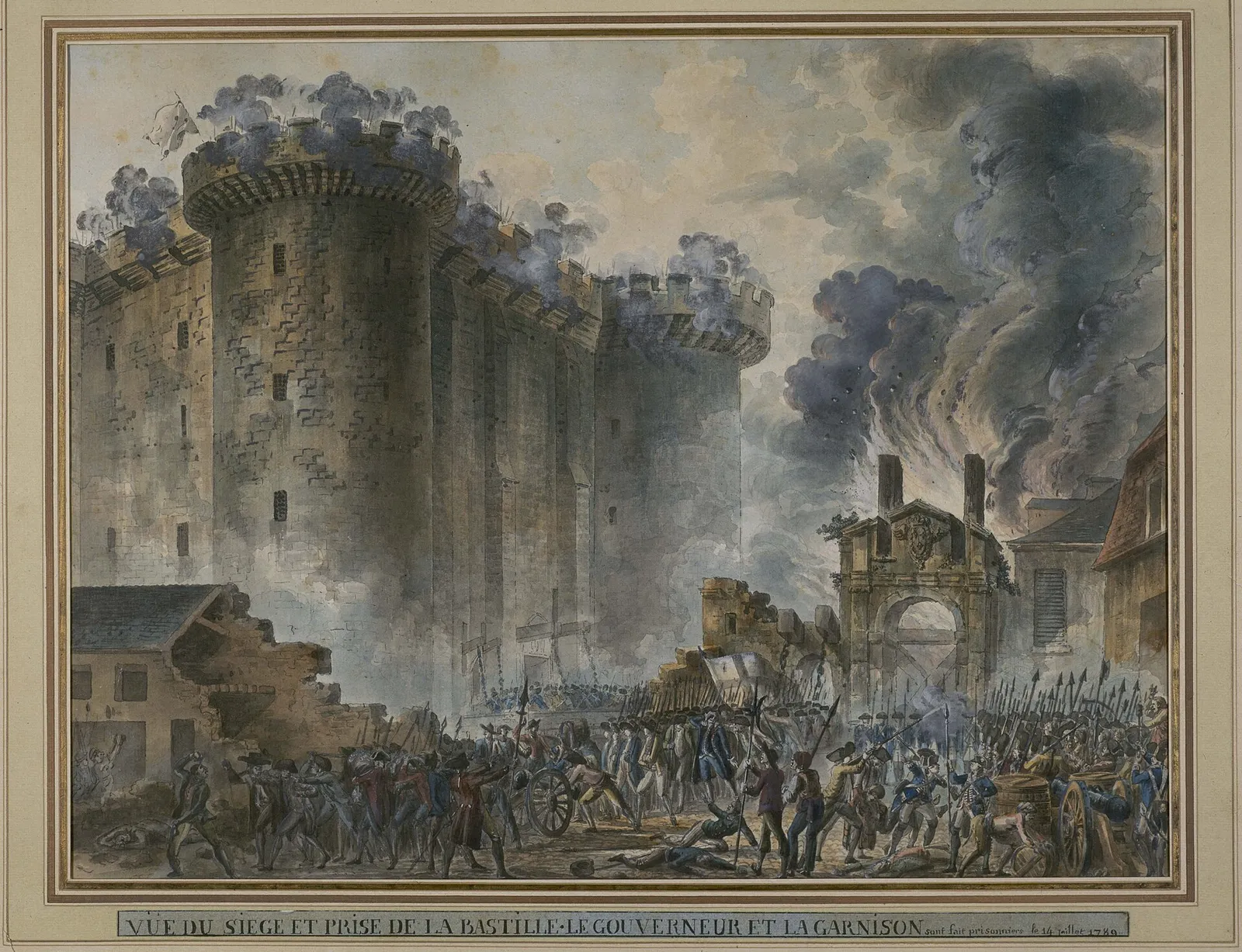
On the morning of the 14th a crowd climbs the ditches of the Invalides and carries off a dozen cannon and 32,000 muskets.[17][19] It then turns towards the Bastille. The first assault costs the attackers about a hundred dead according to the Larousse encyclopedia; the American Gouverneur Morris, who hears of it the same day, writes: “It cost the assailants 60 men, it is said.”[19][20] The French Guards of Hulin and Élie bring cannon up to the drawbridge, and the governor, de Launay, surrenders.[19] Inside the fortress the victors find only seven prisoners.[17][21] On the way to the city hall de Launay is killed, together with three officers and three soldiers.[17][19]
Under the date of 14 July the king's journal carries a single word: “Nothing”. The word has made its own legend. Yet the historian Philippe Lejeune points out that the page was written in August, “in full knowledge”, and that “nothing” simply means there was nothing to record in the journal's usual matter: hunts, receptions, ceremonies, journeys.[16]
July – August 1789
Sovereignty changes hands
What is at stake that summer fits into one sentence, which the Declaration will write in August: “The principle of all sovereignty resides essentially in the nation.”[22] The king does not disappear, but he is no longer the source of power.
The countryside does not stay on the sidelines. From 20 July strange rumours spread, and the tocsin amplifies great panics in the towns and among the peasants.[23] This is the Great Fear, of which Georges Lefebvre wrote the standard study in 1932. Timothy Tackett points out that it weighed on the formation of the National Guard and on the Assembly's renunciation of “feudalism”.[24]
On the night of 4 August it is the vicomte de Noailles, “a younger son of a poor family”, who opens the debate by asking for the abolition of feudal dues, in order to restore calm.[23] Amid general enthusiasm the Assembly abolishes personal and property dues, seigneurial courts, the sale of offices and the privileges of towns and provinces. At three in the morning it proclaims Louis XVI “restorer of French liberty”.[23]
The decree of 11 August turns that night into articles. Its first article takes one line: “The National Assembly entirely destroys the feudal regime.” Others go straight to money: tithes “of every kind” are abolished, so are “pecuniary privileges” in matters of tax, and “justice shall be rendered free of charge”.[25]
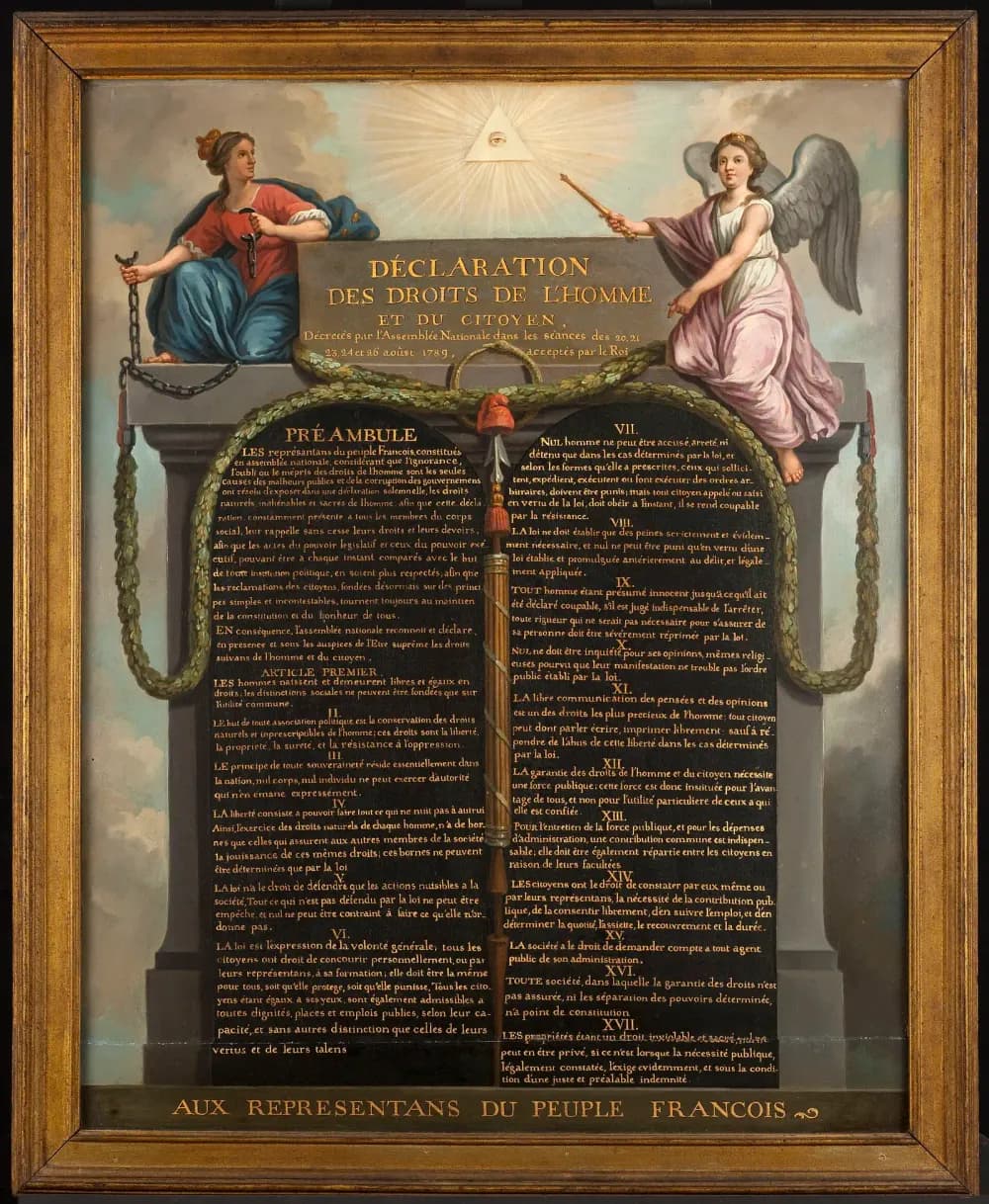
On 26 August the Assembly adopts article 17, the last, of the Declaration of the Rights of Man and of the Citizen.[26] Article 1 proclaims: “Men are born and remain free and equal in rights. Social distinctions may be founded only upon the general good.” Article 6 makes the law “the expression of the general will”. Article 13 answers the financial crisis in its own way: the common contribution “must be equally distributed among all citizens, in proportion to their means”.[22] And article 17 declares property “an inviolable and sacred right”.[26]
A historians' debate: what happened in 1789?
For Georges Lefebvre, in Quatre-vingt-neuf (1939), the year was the meeting of nested revolutions, aristocratic, bourgeois and popular; the historian Bernard Gainot stresses that in Lefebvre they form one and the same process.[27][28] Albert Soboul opened his 1965 account of 1789 with this sentence: “The Revolution marks the advent of bourgeois and capitalist society in the history of France.”[29]
As early as 1954 the British historian Alfred Cobban challenged that reading: the Revolution changed France profoundly in political terms, far less in its social structure. He did not deny that the Third Estate deputies were predominantly bourgeois.[29] François Furet sees 1789 as the political outcome of the cultural unification of noble and bourgeois elites, and as a crisis of political legitimacy rather than a class conflict.[30][29]
The debate then moved towards political culture. Lynn Hunt's book (1984), according to its publisher, refocused the discussion on the political meaning of the Revolution: the discovery that political action could consciously transform society.[31] Timothy Tackett and William Doyle, according to Pamela Pilbeam, put much down to the king's ineptitude and indecision. For Pilbeam, interpretations moved so fast that the label “revisionist”, applied to Cobban, soon became out of date; for Guy Lemarchand, the Revolution is “still not a cold subject”.[29][32]
October 1789 – April 1790
Bread at Versailles, lands for sale
On the morning of 5 October, seven to eight thousand women set out from Paris for Versailles, meaning to “fetch bread”.[33] At the bar of the Assembly the spokesman of this delegation, Maillard, declares: “We have come to Versailles to ask for bread, and at the same time to have punished the bodyguards who insulted the patriotic cockade.”[34] The next morning Morris writes in his diary: “Paris is all in tumult”; two heads of the king's bodyguards are brought to town.[20]
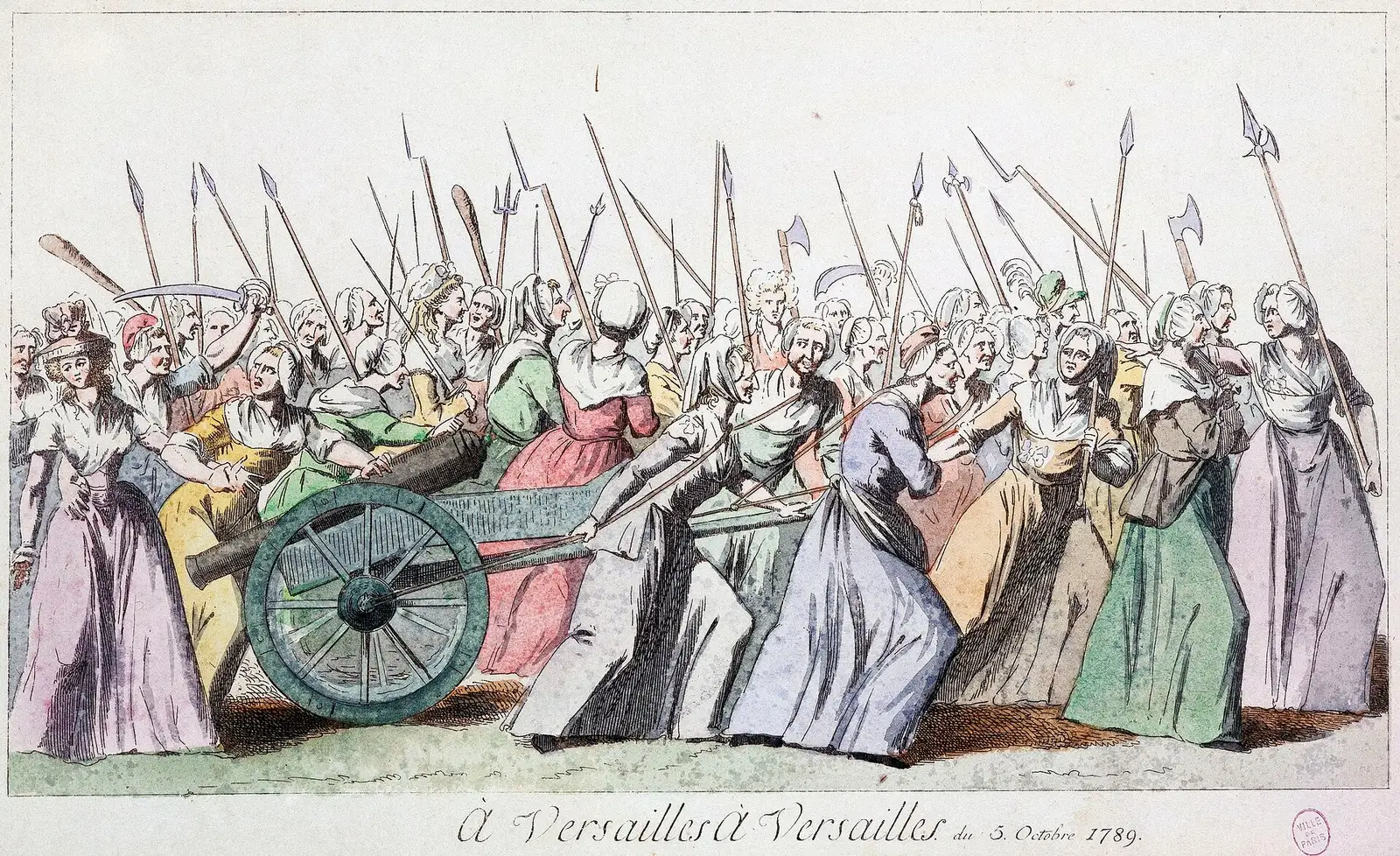
To calm the demonstrators, Louis XVI agrees to come to Paris with his family; after a nine-hour journey he settles at the Tuileries.[33] The Assembly decrees that “the King and the National Assembly are inseparable” and follows him.[35] From now on the king lives under the eyes of Paris.
The debt remains; the Revolution has not wiped it out. On 10 October the bishop of Autun, Talleyrand, presents a motion on Church property: this is not, he says, a mere “contribution to the burdens of the State”.[36] On 2 November, by 568 votes, the Assembly decrees “that all ecclesiastical property is at the disposal of the nation”.[37]
On 19 December it creates an extraordinary fund and puts crown and Church estates up for sale to the value of 400 million. Until the sales take place, it issues assignats of 1,000 livres bearing 5% interest, to be accepted first in payment for these lands, and plans to retire them in instalments from 1791 to 1795.[38] The deputies know the danger: they cite the collapse of John Law's system in 1720 and the American experience as examples of paper money gone wrong. They accept the assignat but reject the national bank that Necker proposed.[6] On 16 April 1790 the assignats become legal tender, “between all persons, throughout the kingdom”.[39]
The kingdom itself is redrawn. The decree of 22 December 1789 provides for dividing it into departments, “to the number of 75 to 85”; the list and boundaries are fixed on 26 February 1790, and the Constitution of 1791 counts 83.[40][41][42]
1790 – 1799
A paper that ended at 1/280
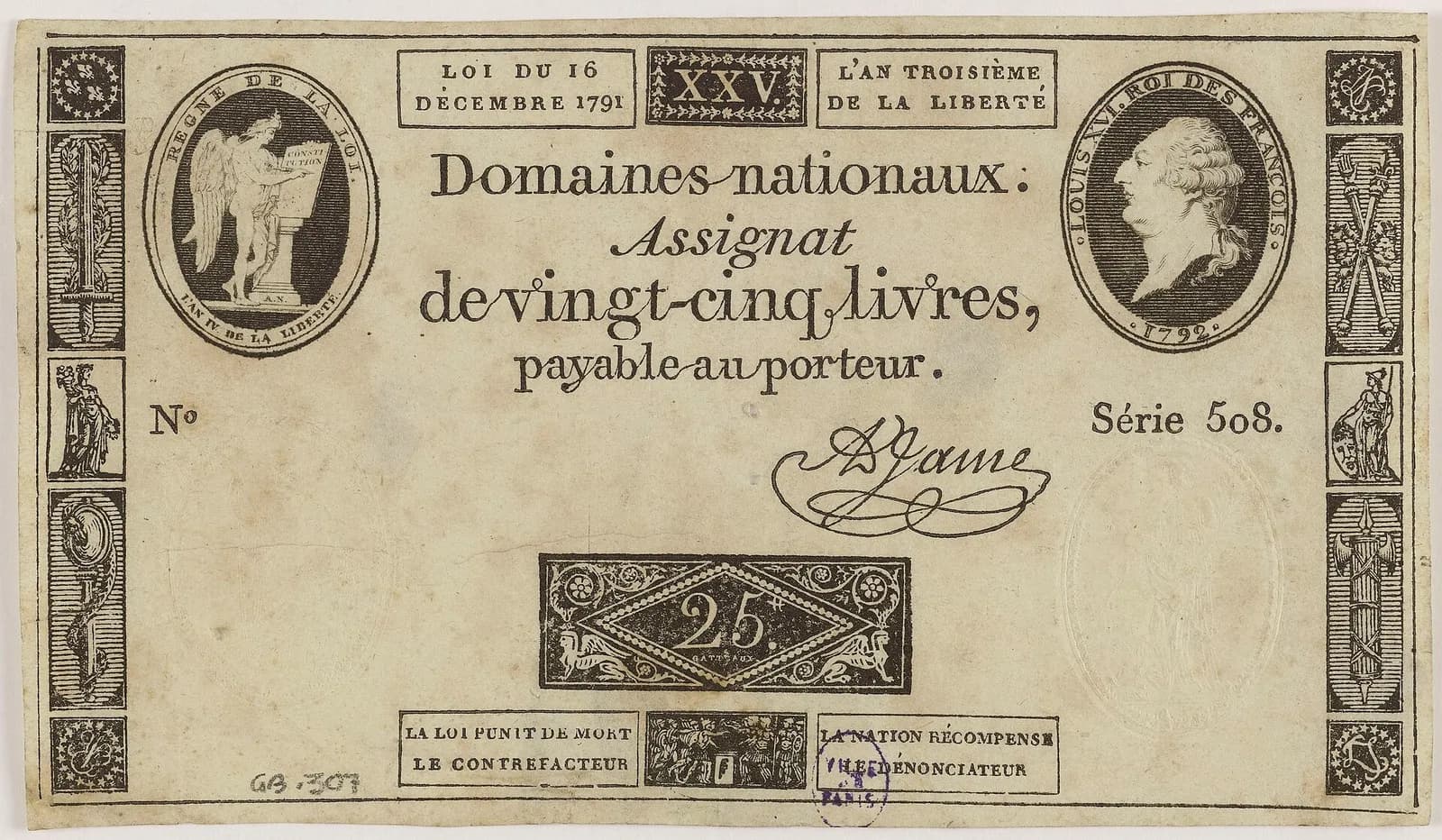
At first the issues of assignats stay limited: 400 million livres in 1789, 1,200 million in 1790, according to Citéco, the Banque de France's museum of economics. Then the pace quickens, above all from April 1794, under the pressure of war spending: cumulative issues rise from 8 billion livres in April 1794 to 45 billion in April 1795.[43] In February 1796, when the printing equipment is destroyed, the assignat is worth no more than a 280th of its original value; it is demonetised on 4 February 1797.[43][6] The episode deepens a distrust of paper money already noticeable since Law.[43]
The monarchy does not survive these years. The Constitution of 1791 proclaims: “There is no longer nobility, nor peerage, nor hereditary distinctions, nor distinctions of orders, nor feudal regime”.[42] On 21 September 1792 the Convention, elected by universal suffrage in two stages by a minority of the French, abolishes the monarchy and proclaims the Republic. Louis XVI is executed on 21 January 1793, and a European coalition forms against revolutionary France.[44]
Contested figures: the dead of the Terror and of the Vendée
According to the calculations of Donald Greer (1935), quoted by the historian Hervé Leuwers, the Terror accounted for some 17,000 executions ordered by special courts; adding executions without trial and deaths in prison, the toll would rise to 35,000 or 40,000.[45] Almost 12,000 of those 17,000 death sentences were handed down in the West and the Southeast, Carla Hesse points out.[46] Jean-Clément Martin considers that it is time to revisit these estimates.[47]
For the Vendée wars, Leuwers gives 140,000 to 190,000 dead, Vendéans and republican soldiers together.[45] Jacques Hussenet arrives at 170,000 dead and missing among the Vendéans, Whites and Blues, a figure Martin accepts.[47] Peter McPhee calls estimates of 500,000 rebel deaths exaggerated.[48] The word genocide, which gives Reynald Secher's book its title, is rejected by Hussenet, Martin and McPhee.[49][47][48]
On the causes, Michel Vovelle invoked the “theory of circumstances”, the double war against the coalition of monarchies and against enemies within.[50] According to Charles Walton, most specialists now attribute revolutionary violence to collective emotions, weak institutions and circumstances rather than to ideology.[51]
On 15 December 1799 the Consuls, Bonaparte among them, present the French with a new Constitution and conclude: “Citizens, the Revolution is settled on the principles that began it: it is over.”[52]
1791 – 1973
What the Republic kept in writing
The Revolution also changed the units of measurement. On 26 March 1791, on Talleyrand's report, the Assembly adopts a decree on the establishment of a unit of measure.[53] The law of 18 Germinal Year III (7 April 1795) defines the metre as one ten-millionth of a quarter of the Earth's meridian.[54] For the International Bureau of Weights and Measures, this metric system and the deposit of two platinum standards in the Archives on 22 June 1799 can be considered the first step towards the International System of Units.[55]
The departments drawn in 1790 appear in article 72 of the Constitution of 1958, among the territorial communities of the Republic.[41][56]
Above all, the preamble to the Constitution of 4 October 1958 proclaims the French people's attachment “to the Rights of Man and the principles of national sovereignty as defined by the Declaration of 1789”.[56] Since its decisions of 16 July 1971 and 27 December 1973, the Constitutional Council has used the Declaration to review laws, and it recognises its “full constitutional value”.[5] Consent to taxation, the issue that had led to the summoning of the Estates-General, is among the principles it draws from it.[5]
The next link
When the Bourbons return, Louis XVIII “grants” a Constitutional Charter on 4 June 1814.[57] It keeps the core of 1789: “The French are equal before the law, whatever their titles and ranks”, and all property is inviolable, “with no exception for that which is called national”. The national lands sold by the Revolution are not given back. But article 14 leaves the king the ordinances “necessary for the execution of the laws and the security of the State”.[58] On 25 July 1830 the king signs four ordinances; according to the National Assembly, “these ordinances will trigger a revolution”.[57] That is the next link, told in the next article of this series.
The series on video
Further reading
- Becoming a Revolutionary: The Deputies of the French National Assembly and the Emergence of a Revolutionary Culture (1789-1790) — Timothy Tackett (Princeton University Press, 1996)
The Assembly of 1789 seen from inside, session by session, through the letters and diaries of its deputies.
- The Coming of the French Revolution — Georges Lefebvre, trans. R. R. Palmer (Princeton University Press, 1947)
The classic account of 1789 as several revolutions in one, aristocratic, bourgeois and popular, by the historian of the Great Fear.
- The Oxford History of the French Revolution — William Doyle (Oxford University Press, 1989)
A clear narrative from the crisis of the monarchy to Bonaparte, by a historian who puts much down to the king's indecision.
- Liberty or Death: The French Revolution — Peter McPhee (Yale University Press, 2016)
A recent synthesis that follows the Revolution in Paris and in the provinces, attentive to ordinary lives.
In the same series
The French revolutions · 1 of 4 articles published
Sources
- Assemblée nationale, Le serment du Jeu de paume, European Heritage Days, 2016
- Jean-Sylvain Bailly, Mémoires de Bailly, t. I, ed. Berville et Barrière, Baudouin frères, 1821 ; Internet Archive
- Assemblée nationale, Jean-Sylvain Bailly, Heritage Days, 2010
- Archives parlementaires, Décret du 20 juin 1789 et serment du Jeu de paume, 1st series, vol. VIII ; Persée
- Conseil constitutionnel, La Déclaration des droits de l'homme et du citoyen du 26 août 1789
- Thomas J. Sargent et François R. Velde, Macroeconomic Features of the French Revolution, Journal of Political Economy, 103/3, 1995, p. 474-518
- Marie-Laure Legay, Joël Félix et Eugene White, Retour sur les origines financières de la Révolution française, Annales historiques de la Révolution française, 356, 2009
- Anne-Pierre de Montesquiou-Fezensac, au nom du comité des finances, Mémoire sur les finances du royaume (séance du 9 septembre 1791), Archives parlementaires, 1st series, vol. XXX ; Persée
- Roy Rosenzweig Center for History and New Media (George Mason University) and American Social History Project (CUNY), Calonne, Programs of Reform, Address to Assembly of Notables (1787), Liberty, Equality, Fraternity: Exploring the French Revolution
- Roy Rosenzweig Center for History and New Media (George Mason University) and American Social History Project (CUNY), The Estates-General are convoked for 1 May 1789, Liberty, Equality, Fraternity: Exploring the French Revolution
- Keraunos, French observatory of tornadoes and severe thunderstorms, Orages de grêle du 13 juillet 1788
- Donald M. G. Sutherland, George Rudé's The Crowd in the French Revolution: The First 60 Years, H-France et George Rudé Society, forum anniversaire, 2019
- Arthur Young, Voyages en France pendant les années 1787, 1788, 1789, trans. H. J. Lesage, Guillaumin, 1882 ; Project Gutenberg
- Assemblée nationale, Sieyès, Mirabeau et Bergasse : le tiers état se constitue en Assemblée nationale (15-17 juin 1789), Les grands discours parlementaires
- Yves Durand, États généraux (France) : 1789, Encyclopædia Universalis
- Philippe Lejeune, « Rien ». Journaux du 14 juillet 1789, in Le Bonheur de la littérature. Variations critiques pour Béatrice Didier, PUF, 2005
- Pascal Dupuy, L'arrestation du gouverneur de la Bastille, le 14 juillet 1789, L'Histoire par l'image, GrandPalaisRmn
- City of Paris, Camille Desmoulins et les orateurs du Palais-Royal, Parcours Révolution
- Larousse encyclopedia, la Bastille
- Gouverneur Morris, The Diary and Letters of Gouverneur Morris, vol. 1, ed. Anne Cary Morris, Scribner, 1888 ; Internet Archive
- City of Paris, La Bastille, Parcours Révolution
- Conseil constitutionnel, Déclaration des droits de l'homme et du citoyen de 1789
- Assemblée nationale, Target, Noailles et Aiguillon : abolition des droits féodaux (nuit du 4 août 1789), Les grands discours parlementaires
- Timothy Tackett, La Grande Peur et le complot aristocratique sous la Révolution française, Annales historiques de la Révolution française, 335, 2004
- Archives parlementaires, Décret du 11 août 1789 relatif à l'abolition des privilèges, 1st series, vol. VIII ; Persée
- Archives parlementaires, Adoption de l'article 17 de la Déclaration des droits, séance du 26 août 1789, 1st series, vol. VIII ; Persée
- Guillaume Mazeau, Lefebvre (Georges) : un historien au présent, Encyclopædia Universalis
- Bernard Gainot, Review of Georges Lefebvre, Quatre-vingt-neuf (réed. 2023), Cahiers d'histoire. Revue d'histoire critique, 161, 2024
- Pamela Pilbeam, The Historiography of the 1789 Revolution from Alfred Cobban to Recent Times, George Rudé Society et H-France
- Julien Louvrier, Penser la controverse : la réception du livre de François Furet et Denis Richet, La Révolution française, Annales historiques de la Révolution française, 351, 2008
- University of California Press (publisher's description), Lynn Hunt, Politics, Culture, and Class in the French Revolution
- Guy Lemarchand, Review of Michel Vovelle, 1789. L'héritage et la mémoire, Annales historiques de la Révolution française, 351, 2008
- Jean Tulard, Octobre 1789 (journées des 5 et 6), Encyclopædia Universalis
- Archives parlementaires, Députation de Paris et discours de Maillard, séance du 5 octobre 1789, 1st series, vol. IX ; Persée
- Archives parlementaires, Décret du 6 octobre 1789 portant que le Roi et l'Assemblée nationale sont inséparables, 1st series, vol. IX ; Persée
- Archives parlementaires, Motion de M. de Talleyrand sur les biens ecclésiastiques, séance du 10 octobre 1789, 1st series, vol. IX ; Persée
- Archives parlementaires, Décret du 2 novembre 1789 sur les biens ecclésiastiques, 1st series, vol. IX ; Persée
- Archives parlementaires, Décret du 19 décembre 1789 sur la caisse de l'extraordinaire, 1st series, vol. X ; Persée
- Archives parlementaires, Décret sur les assignats, séance du 16 avril 1790, 1st series, vol. XIII ; Persée
- Archives parlementaires, Décret du 22 décembre 1789 sur la constitution des assemblées représentatives et administratives, 1st series, vol. XI ; Persée
- Archives d'Alsace, education service, Le département, un modèle à géométrie variable
- Conseil constitutionnel, Constitution de 1791
- Citéco, Cité de l'économie (Banque de France), La presse à assignats
- Larousse encyclopedia, Convention nationale
- Hervé Leuwers, La Terreur durant la Révolution française (1793-1794), Encyclopédie d'histoire numérique de l'Europe, Sorbonne Université
- Carla Hesse, Terror and the Revolutionary Tribunals, H-France Salon, 11/16, 2019
- Jean-Clément Martin, Review of Jacques Hussenet (dir.), « Détruisez la Vendée ! », Annales historiques de la Révolution française, 354, 2008
- Peter McPhee, Vicious Civil War in the French Revolution, The Cambridge World History of Genocide, Cambridge University Press, 2023 (chapter abstract)
- University of Notre Dame Press (publisher's description), Reynald Secher, A French Genocide: The Vendée
- Guy Lemarchand, Review of Michel Vovelle, 1789. L'héritage et la mémoire, Annales historiques de la Révolution française, 351, 2008
- Charles Walton, La Terreur réinterprétée, La Vie des idées, 2019
- Conseil constitutionnel, Constitution du 22 frimaire an VIII et proclamation des Consuls
- Archives parlementaires, Décret relatif à l'établissement d'une unité de mesure, séance du 26 mars 1791, 1st series, vol. XXIV ; Persée
- Observatoire de Paris, Le mètre : mesure républicaine
- Bureau international des poids et mesures, Le Système international d'unités (SI), 9e édition, 2019
- Conseil constitutionnel, Texte intégral de la Constitution du 4 octobre 1958 en vigueur
- Assemblée nationale, 1814-1848 : de la Restauration à la monarchie de Juillet, les faits
- Conseil constitutionnel, Charte constitutionnelle du 4 juin 1814
This article was prepared with the help of artificial intelligence from verified sources, then reviewed, corrected and approved by the author. Our method.
It is a translation of the original French article.