The thread · topic 1/22 · 334 BC
Alexander the Great and the Persian Treasure: Money in Motion
331 BC: Alexander defeats Darius III, seizes the Persian treasure and turns it into coin. His money outlived him by two centuries; then the pattern returned.
Listen to this article· 16 min · read by a synthetic voice (Google)
Contents
On the evening of 20 September 331 BC, astronomers in Babylon watched the Moon vanish in a total eclipse and noted it on a clay tablet.[1][2] Eleven days later the same tablet recorded a rout: the Persian king, Darius III, had been deserted by his troops in the face of the man it called the “king of the world”, Alexander of Macedon.[2] In the months that followed, the victor took the gold and silver that Persian kings had been piling up for generations, and turned it into coins in his own name, coins that would outlive him by two centuries.[3]
- 331 BCGaugamelaOn 1 October Alexander defeats Darius III; Babylon surrenders.
- 330 BCThe vaults of Susa and PersepolisTens of thousands of talents of gold and silver change hands.
- 325 BCMetal becomes moneyThousands of talents are struck into coins in Alexander's name.
- 323 BCA dead king who still paysHis generals keep striking his coinage to pay their armies.
- 3rd century BCA common currencyFifty-one mints are still striking “Alexanders”.
- 1780The pattern returnsThe Maria Theresa thaler, frozen at that date, is still struck today.
September 331 – July 330 BC
Eleven days between the eclipse and the rout
The tablet is an astronomical diary. Night after night, the scholars of Babylon recorded in it the positions of the stars and planets, then the prices of staple goods, the level of the river and whatever news reached them.[2] The news in September 331 was bad for the Great King. On the 11th of the month, by the scribes' calendar, panic broke out in his camp. On the 13th, the Moon was eclipsed. On the morning of the 24th, the “king of the world” raised his standard. That king of the world, the historian Jona Lendering explains, is Alexander.[2]
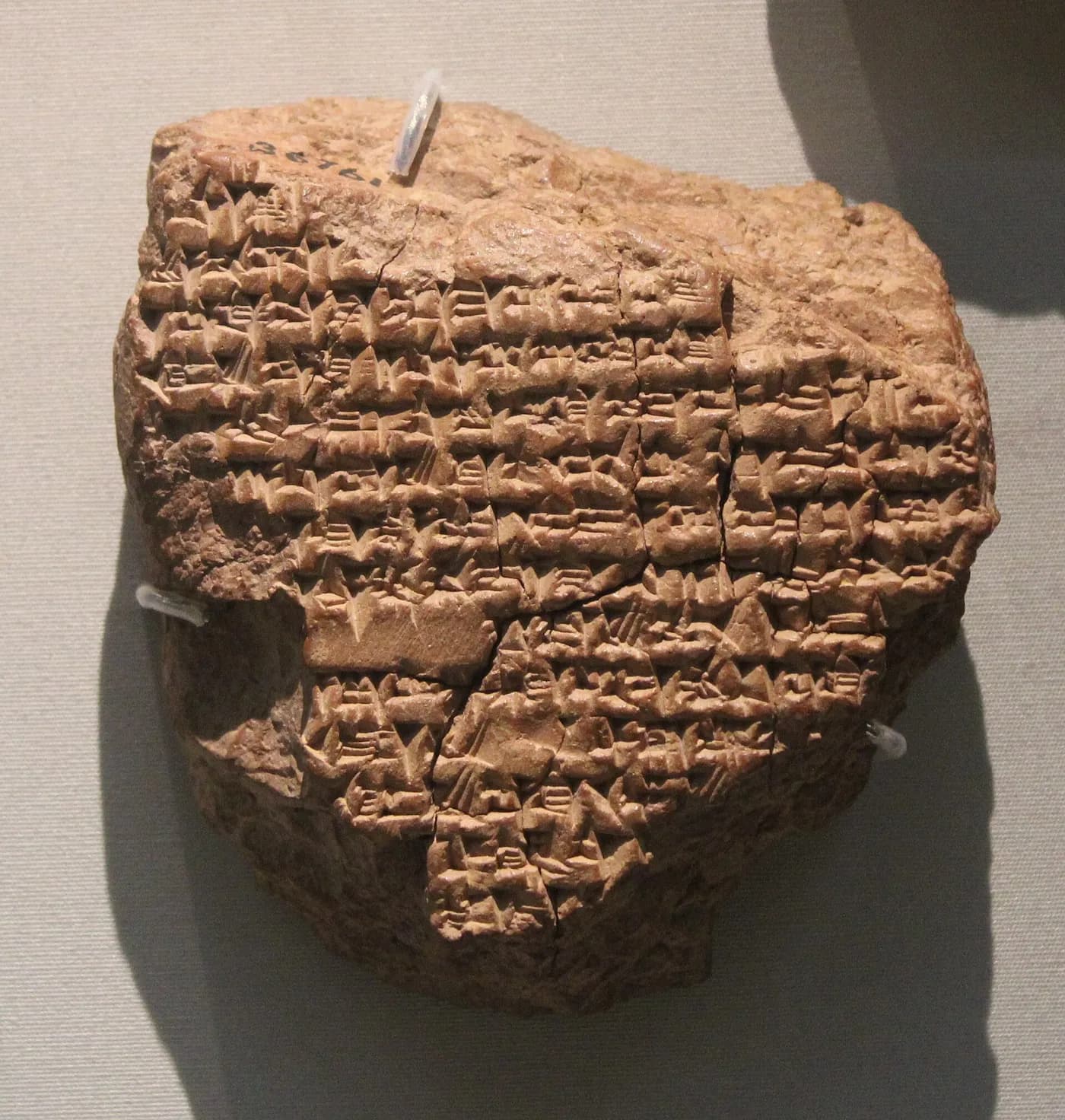
The date is 1 October 331, the place Gaugamela.[2] The two armies met, and the Persian troops suffered a heavy defeat. The scribe adds a line that the Greek historians do not tell in quite this way: “The king, his troops deserted him.”[2] In the Greek historian Arrian, by contrast, it is Darius, long gripped by fear, who is “the first to turn and flee”.[4]
The road to Babylon lay open. The Babylonians came out in crowds to meet the victor, with their priests and magistrates, and handed over the city, the citadel and the money.[4] From Sippar, Alexander had sent them a promise, which the tablet copies out: “Into your houses I shall not enter.” His soldiers would not plunder the city.[2]
Twenty days' march later he entered Susa and took possession of the royal treasure: 50,000 talents, according to Arrian.[4] Diodorus Siculus counts more than 40,000 talents of gold and silver bullion, plus 9,000 talents of gold coined as darics, the gold pieces of the Persian kings.[5] Quintus Curtius insists that the silver had not been struck into coin at all, but cast in rough ingots.[6] The palace also held 5,000 talents' weight of purple from Hermione, stored there for 190 years and, so Plutarch was told, with its colours still fresh.[7] And there were the bronze statues of Harmodius and Aristogeiton, which Xerxes had carried off from Greece. Alexander sent them back to the Athenians.[4]
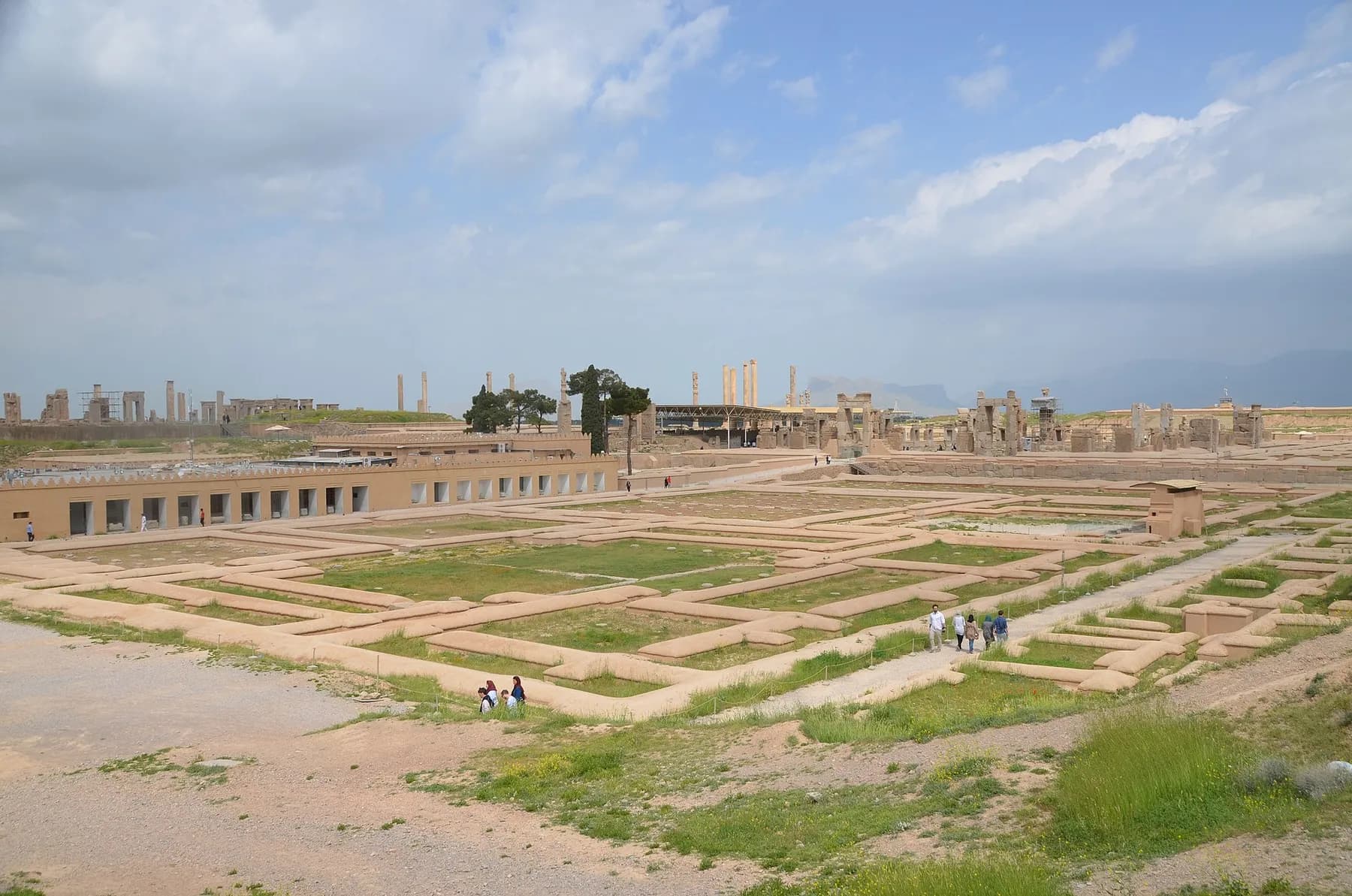
That left the heart of the treasure. Alexander hurried on to Persepolis, to get there before its guards could plunder the vaults.[4] Diodorus describes them as “packed full of silver and gold”, accumulated since Cyrus, the founder of the empire, and gives the total: 120,000 talents, with the gold reckoned at its value in silver.[5] Quintus Curtius gives the same figure, and adds 6,000 talents taken at Pasargadae.[6] Carrying it all away took pack animals by the thousand: 3,000 camels and a multitude of mules in Diodorus, 10,000 pairs of mules and 5,000 camels in Plutarch.[5][7]
Then Alexander burned the palace. His general Parmenion tried to dissuade him: why destroy what was now his own property? Alexander replied that he was avenging Greece, for Athens razed and its temples burned by the Persians. Arrian did not think he had acted “with prudence”, and adds that on his return, years later, Alexander himself no longer approved of it.[4]
According to some writers quoted by Strabo, all the treasures ended up gathered at Ecbatana, in Media, and were valued at 180,000 talents; Diodorus puts Parmenion in charge of them.[8][5] As for Darius, his own officers wounded him and left him behind in his flight. He died in July 330, before Alexander could see him.[4]
How far to trust the ancient figures
The ancient writers do not agree. At Susa, Arrian and Quintus Curtius count 50,000 talents; Plutarch counts 40,000 in coin, and Diodorus 40,000 as well, but in bullion.[4][7][5] Strabo allows only 40,000 talents, or 50,000, for Susa and Persis together.[8] The historian Frank Holt has cross-checked these “fragmentary and imprecise” figures and puts the haul from the royal palaces at between 180,000 and 200,000 talents, not counting works of art.[9] By weight, the Bundesbank reckons 180,000 talents at about 4,700 tonnes of metal.[10]
331–323 BC
Silver asleep in jars
To see what changed, start with what the Great Kings did with their gold. Herodotus described it. The king melts down the tribute and pours it into earthenware jars; when a jar is full he breaks away the pot, and when he needs money he cuts off as much as he requires.[11] Under Darius I, by his count, that tribute came to 14,560 talents a year.[11] Strabo confirms the principle: the Persians kept most of their gold and silver in the form of objects, and struck coin only in proportion to what they spent.[8]
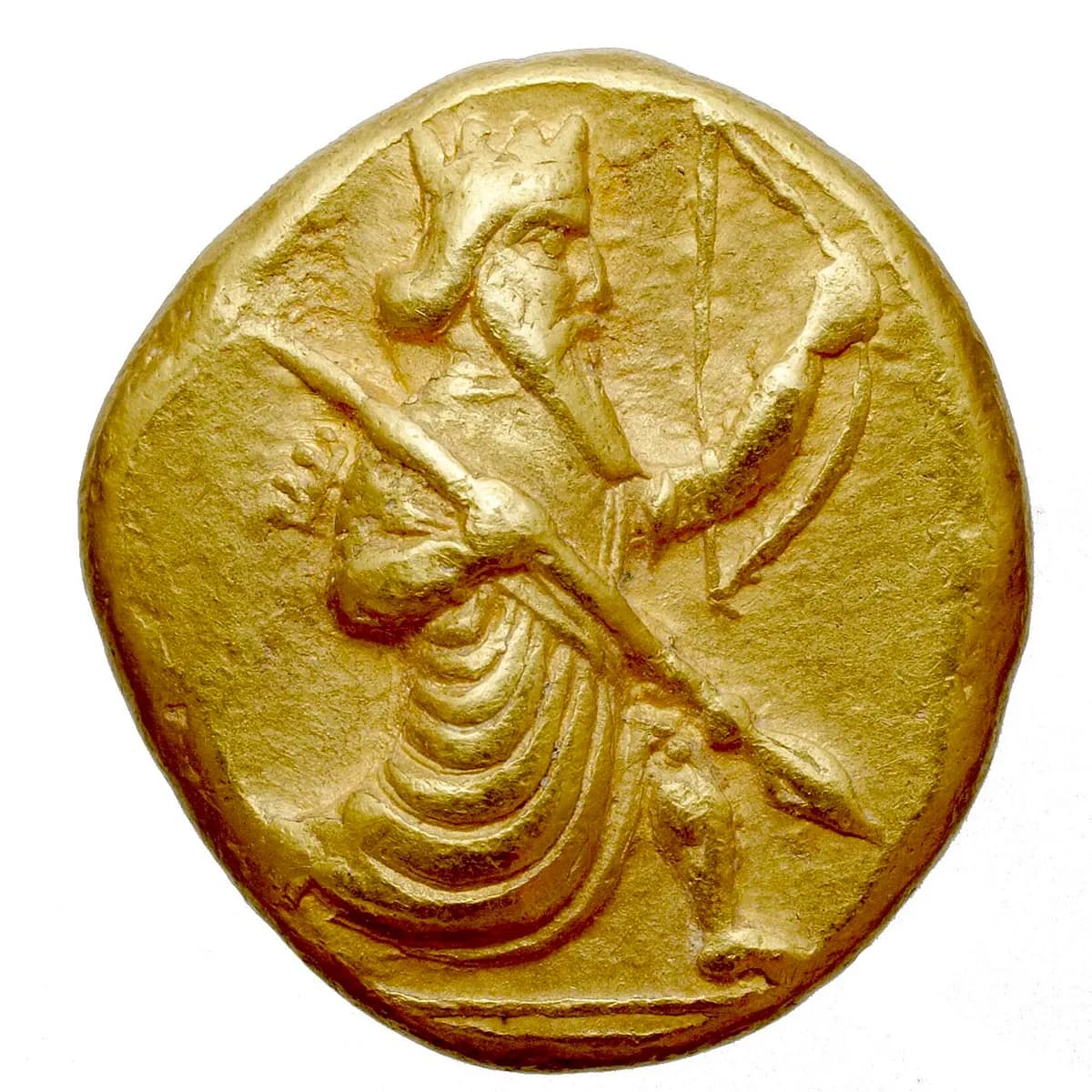
So the metal slept. This royal hoarding, as the Encyclopaedia Iranica puts it, “drained gold and silver from the market”.[12] In Babylonia, people still paid mostly with weighed pieces of silver. Coinage existed in the Persian empire, notes the historian R. J. van der Spek, but in Babylonia and Persia it was hardly used.[13]
Alexander would put that metal back into circulation. His silver coins, the tetradrachms, show on one side Heracles in his lion skin, the hero from whom Alexander claimed descent, and on the other Zeus on his throne, an eagle in his hand.[14] None of them bears his face. The name ΑΛΕΞΑΝΔΡΟΥ, “of Alexander”, was enough to identify the king.[14][15] All were struck on the Attic standard, whereas his father Philip had struck his silver on the Macedonian standard. In his lifetime twenty-five mints produced them: two in Macedonia, one in Egypt and twenty-three in Asia.[16]
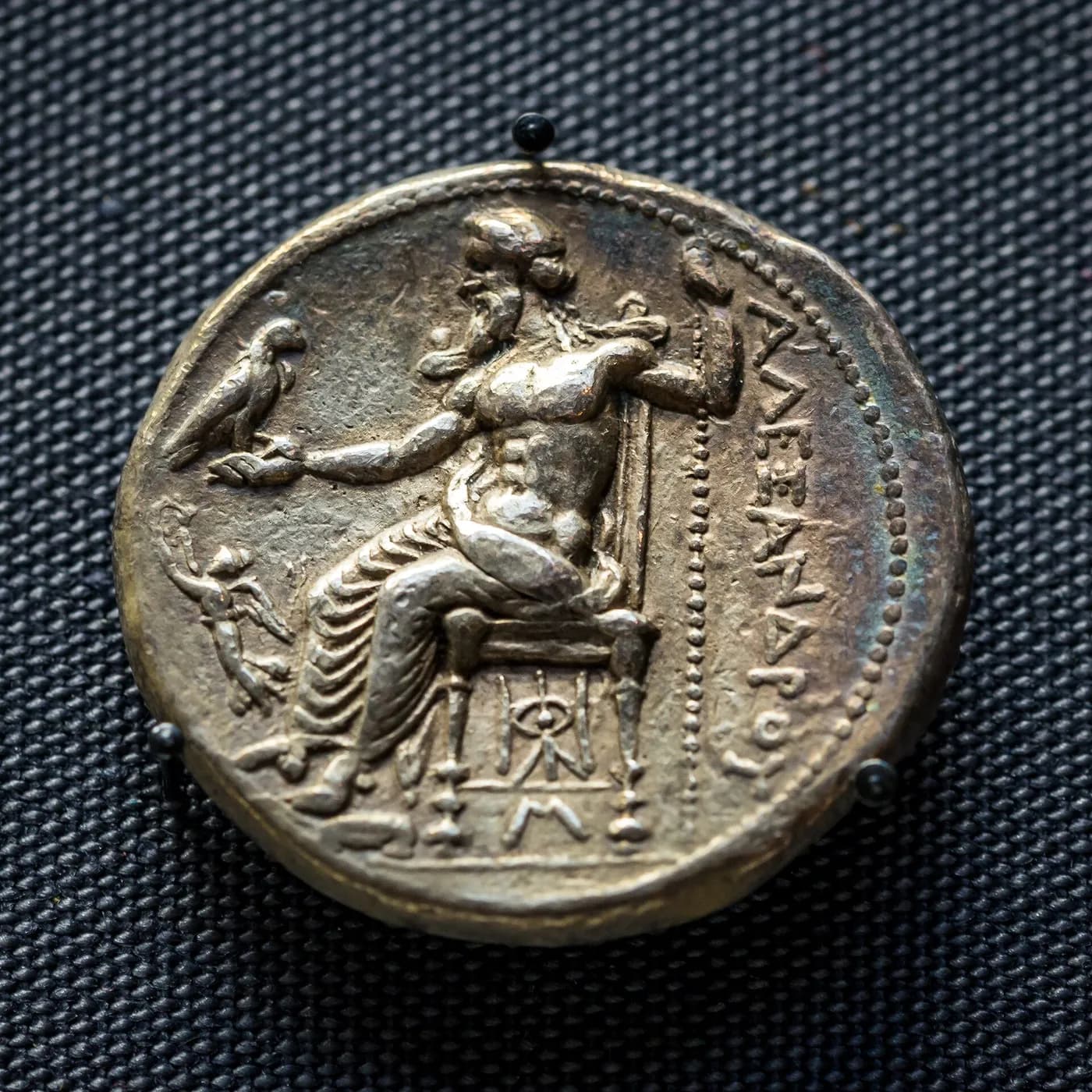
But when did the silver of Persepolis become coin? Later than one might think. For the numismatist Georges Le Rider, Alexander at first preferred to spend the Persian funds as they came, darics included; only from the end of 325 were thousands of talents turned into coins in his name.[17] In June 323 his coinage had still not taken hold east of the Tigris.[17]
The great payouts followed. Back at Susa, Alexander had tables laden with money set up in the camp and settled his soldiers' debts without even taking down their names: 20,000 talents, according to Arrian.[4] Plutarch sets the scene at the feast for the Susa weddings, where the host paid his guests' debts and the whole outlay came to 9,870 talents.[7] Each veteran sent home received his pay up to his return, and a talent on top.[4] The Great Kings' metal was out of the vaults.
A historians' debate: did the Persian treasure enrich the East?
The idea has long been attractive. By coining tons of Persian gold and silver, Alexander was supposed to have woken up a Persian economy thought to be stagnant.[9] Germany's Bundesbank echoes it: for Alexander, this metal “served as a basis for large-scale coin minting”.[10] Georges Le Rider judged that the abundance of coin, far from harming the economy of the Seleucid kingdom, had made it more prosperous still.[18]
Frank Holt disagrees. In his view Alexander took little interest in his own coinage, was slow to change the Persian system and coined only part of the metal he seized; to see his coinage as a stimulus is to misread the nature of the ancient economy.[9] Recent research offers a partial answer. According to the team of Janne Blichert-Toft and François de Callataÿ, Persian silver did go into most of Alexander's coinage, and to an even greater extent into that of his successors.[19]
323–280 BC
A dead king who still pays
In Babylon, the scribe of the astronomical diary wrote under the 29th of the month of Ajaru: “The king died. Clouds.”[20] It was 11 June 323, late in the afternoon.[1] According to Aristobulus, as Arrian reports him, Alexander had lived thirty-two years and eight months.[4]
His generals fought over the empire, and began by keeping his money. These Diadochi, or successors, went on striking his coins without changing a thing, not even adding their own names.[10] Far from stopping, the output of Alexanders grew until about 280.[21] Ptolemy, the future king of Egypt, almost certainly paid for his defence against his rival Perdiccas with standard Alexanders, which mercenaries liked, before launching types of his own.[15]
The Persian treasure was not yet spent, and everyone wanted a share. Antigonus, one of the contenders, seized 600 talents of silver on their way from Cilicia to the kings in Macedonia, explaining that he needed it to pay his mercenaries.[22] A few years later, at Ecbatana, he still found 5,000 talents of uncoined silver; with the treasury of Susa he gathered 25,000 in all. At Cyinda, in Cilicia, he took 10,000 more.[22] His son Demetrius would find another 1,200 talents there, and have them loaded onto his ships.[23]
The Babylonians paid the bill. Their farm prices, recorded in the astronomical diaries, rose sharply after Alexander's death and did not return to normal for more than twenty years, according to the economist Peter Temin.[24] In 309, the year Antigonus plundered Babylon and its countryside, a shekel of silver bought only 6 litres of barley, where the “ideal” price gave 180.[25]
A historians' debate: war or money?
Why the surge? R. J. van der Spek first saw it as the effect of war: the arrival of a large army is enough to drive prices up, even without a battle.[24][26] With C. A. Mandemakers, he also accepts a monetary cause. A large quantity of silver put into circulation lowers the value of the metal, and so raises prices.[26] Peter Temin brings the two explanations together: the rival claimants to the succession probably paid their soldiers out of Alexander's treasure.[24] For Aneurin Ellis-Evans and Jonathan Kagan, inflation was the main economic effect of all this new money.[27]
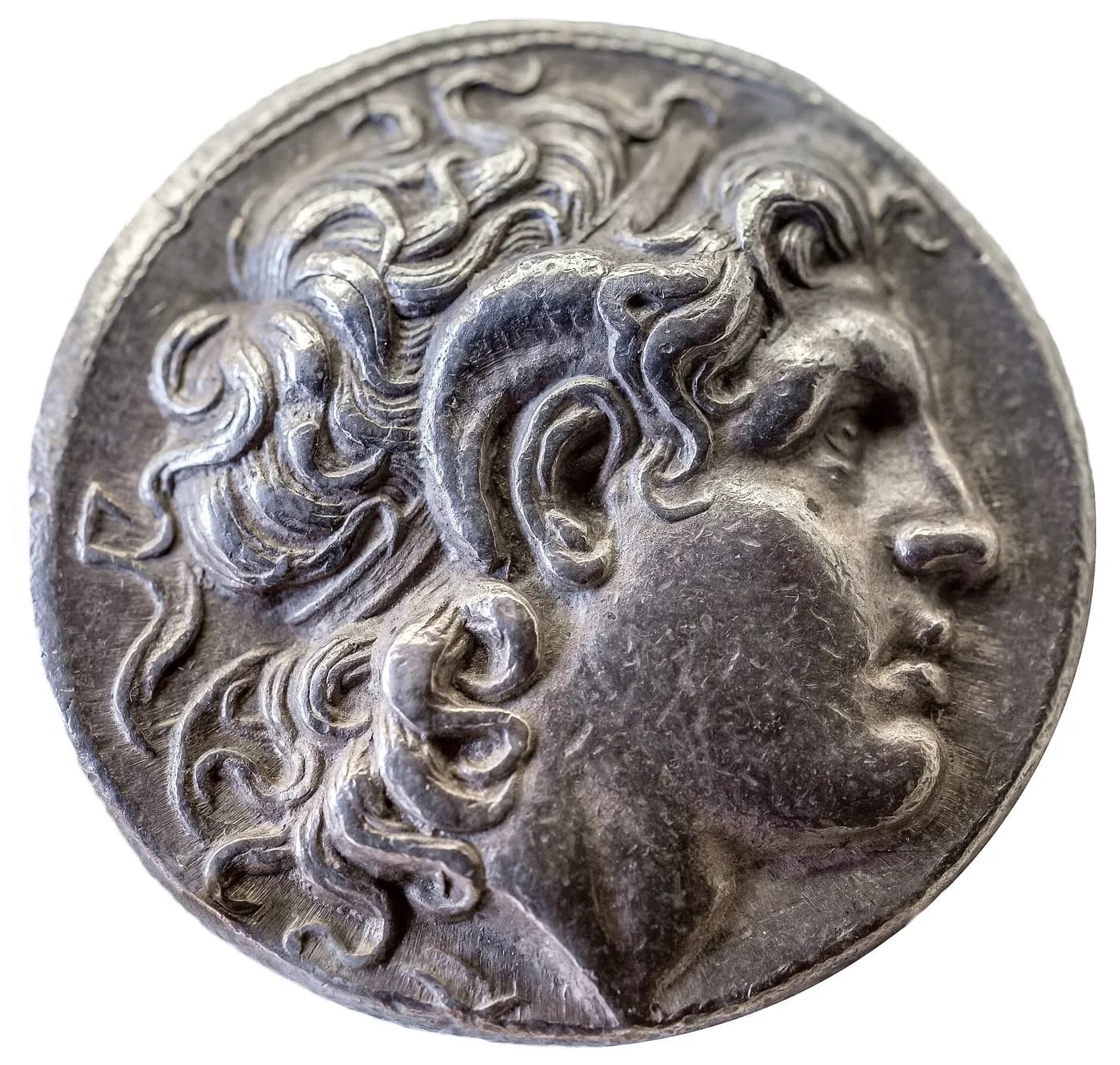
Then the heirs grew bolder. After the battle of Ipsus in 301, many kings stopped striking in Alexander's name and with his types, and put their own names, portraits and royal titles on their coins.[28] Alexander's face, though, was still a safe bet. Lysimachus, one of his former generals, now king in Thrace, put the head of the dead king on his tetradrachms, deified and wearing the horn of the god Ammon, to stress his ties to him.[28][29] The king of Egypt had got there first, with an Alexander wearing an elephant scalp.[30]
3rd–1st century BC
The coin that outlived its kingdom
Alexander's empire did not survive his death. His coinage did. Alexanders went on being struck and used for two centuries, until they became what the Orient & Méditerranée research centre of the CNRS calls the international currency of the Hellenistic world. It was a common currency, though not a single one: cities, kingdoms and leagues struck it for their dealings abroad, alongside their own local coins.[3]
The archaeologist Zoë Kontes gives a sense of the scale. Twenty-five mints were striking Alexanders in the king's lifetime, thirty-one just after his death, and fifty-one still in the last quarter of the third century, more than a hundred years on.[16] The historian Selene Psoma counts about 130 in all, and calls it “a posthumous coinage par excellence”.[31]
Number of mints striking Alexanders
| period | mints |
|---|---|
| In Alexander's lifetime | 25 |
| Just after his death | 31 |
| Last quarter of the 3rd century BC | 51 |
In Babylonia, the conquest of 331 made coined silver the main currency, as Janne Blichert-Toft's team points out, following van der Spek.[19] Van der Spek himself counts the arrival of coinage among the main innovations of the Hellenistic period in the region.[13] And the Attic standard that Alexander imposed became the standard of almost the whole Hellenistic world. The exception was the Ptolemaic territories, which their king had turned into a closed monetary zone. Everywhere else, coins of the same weight travelled from one end of that vast world to the other.[31]
The Great Kings' metal changed shape without disappearing. Recent analyses show that the coins of the Macedonian kings in the third century have the same metallic profile as the Alexanders struck at Amphipolis between about 323 and 300 with metal taken in the East. Old Alexanders, it seems, were melted down to make new coins.[32]
From the 220s the minting even enjoyed a revival, including at mints that had never struck Alexanders until then. It largely stopped before the middle of the second century, except around the Black Sea, and the coins went on circulating after that.[21] In the first half of the first century BC, a Roman quaestor in Macedonia, Aesillas, was still putting a head of Alexander on his tetradrachms.[30]
1741–1970
Maria Theresa, or the coin that would not die
The same pattern returned two thousand years later, in Habsburg Europe. In 1741 a silver thaler was struck bearing the portrait of the Empress Maria Theresa.[33] Used in trade with the eastern Mediterranean, it became very well known in the Arab world.[34] The empress died in 1780. Merchants from Augsburg then asked her son, Joseph II, to go on striking the thaler with his mother's portrait, and the date on the coin stayed frozen at 1780.[35][33]
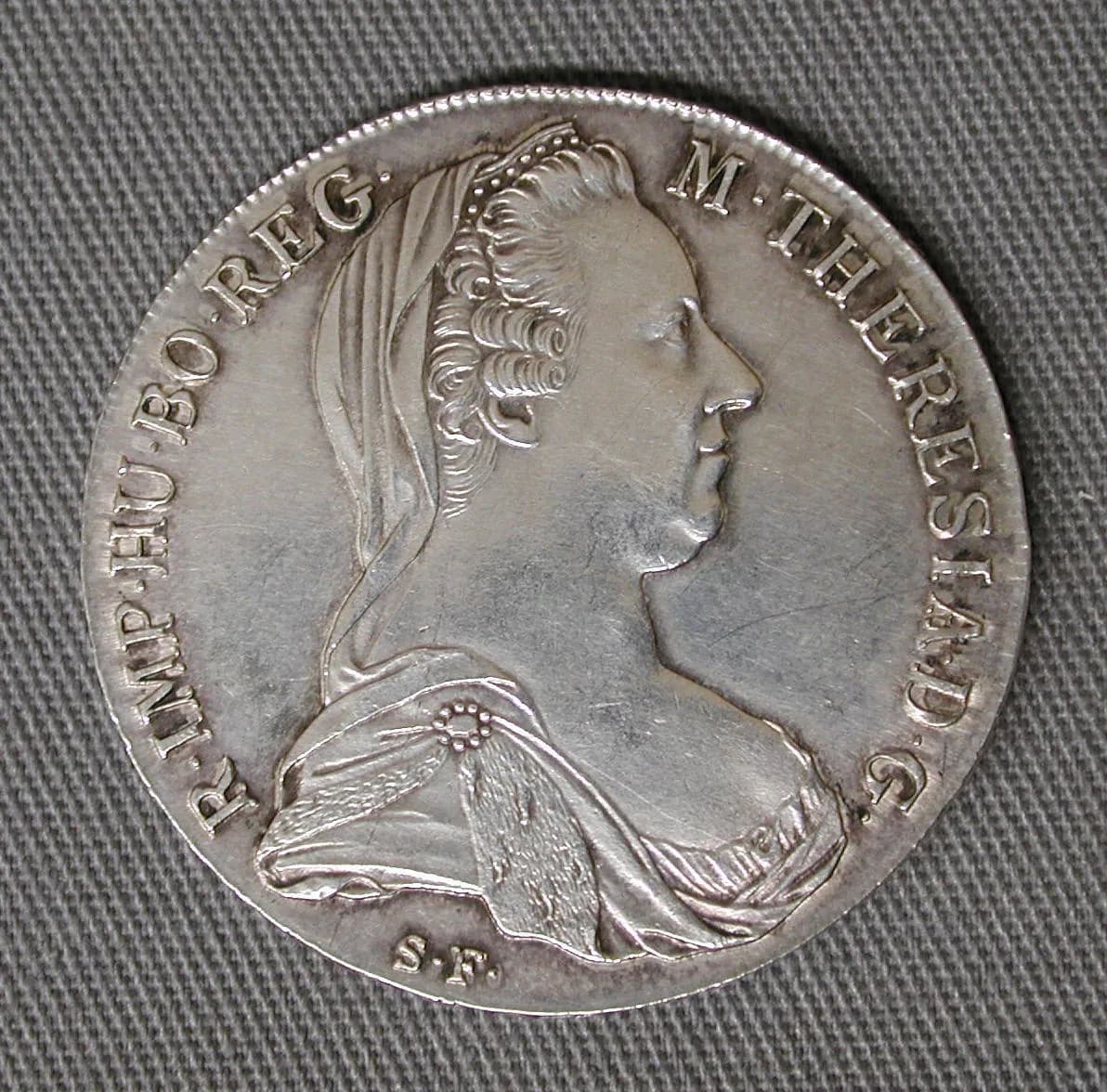
Like the Alexanders, the thaler outlived the ruler who had it struck. The Fitzwilliam Museum in Cambridge catalogues one of these coins as a “posthumous restrike”.[36] Rome, London, Paris, Brussels and even Bombay struck faithful copies.[37] London alone turned out more than 14 million between 1936 and 1941.[38]
The coin circulated in Africa, the Levant and Arabia as a commodity money, worth its weight in silver, until governments one after another imposed national currencies.[39] In Muscat and Oman it was still in use in 1970.[38] It has never stopped being struck: the Austrian Mint has produced it without a break since 1857, still in its 1780 form.[33][34] Total output is put at around 400 million coins, though the records are incomplete.[38]
No historian, to our knowledge, explicitly sets the two coinages side by side; the parallel is ours. Yet it sheds light on what Alexander set in motion. A coin of good weight, whose design never changes, earns a trust that reaches beyond the power that struck it. The merchant who takes it is not extending credit to a king; he is recognising a weight of silver. The metal that the Great Kings left asleep in their jars passed through Alexander's mints and became a currency still being struck long after him.
The next link
Before marching against Darius, Alexander had stopped on the Egyptian coast at a spot that seemed to him “a very fine one in which to found a city”, and had marked out its boundaries, its market square and the sites of its temples himself.[4] The city bears his name, Alexandria, and what his successors built there, a library and a home for scholars, is the next link in the chain.
Further reading
- The Treasures of Alexander the Great — Frank L. Holt (Oxford University Press, 2016)
The book that puts figures on the Persian haul and questions the idea that Alexander used it to stimulate the economy.
- Alexander the Great: Coinage, Finances, and Policy — Georges Le Rider, trans. W. E. Higgins (American Philosophical Society, 2007)
A great numismatist on how Alexander paid for his conquest and struck his coinage: demanding, but the standard work.
- Darius in the Shadow of Alexander — Pierre Briant (Harvard University Press, 2015)
The leading historian of the Persian empire reads the last Great King through the accounts of his conquerors, and gives him back a life of his own.
- Alexander of Macedon, 356-323 B.C.: A Historical Biography — Peter Green (Penguin, 1974; University of California Press, 1991)
A lively and sceptical biography of the conqueror, for readers who want the whole campaign.
Sources
- Jona Lendering, Alexander the Great: Last days, Livius.org
- Babylonian astronomical diary (BM 36761), presented by Jona Lendering, A contemporary account of the battle of Gaugamela, Livius.org; translation after A. J. Sachs and H. Hunger, Astronomical Diaries and Related Texts from Babylonia, I, 1988
- UMR 8167 Orient & Méditerranée (CNRS, Sorbonne Université), Les alexandres après Alexandre. Histoire d'une monnaie commune, presentation of the volume edited by S. Kremydi and M.-C. Marcellesi, 2019 (in French)
- Arrian, Anabasis of Alexander, English trans. E. J. Chinnock, London, 1884; Project Gutenberg
- Diodorus Siculus, Library of History, Book XVII, English trans. C. Bradford Welles, Loeb, 1963; LacusCurtius
- Quintus Curtius Rufus, History of Alexander, Book V, English trans. J. C. Rolfe, Loeb, 1946; Internet Archive
- Plutarch, Life of Alexander, English trans. B. Perrin, Loeb, 1919; LacusCurtius
- Strabo, Geography, Book XV, English trans. H. L. Jones, Loeb, 1930; LacusCurtius
- William D. Barry, Review of F. L. Holt, The Treasures of Alexander the Great (Oxford University Press, 2016), Bryn Mawr Classical Review, 2017.01.18
- Deutsche Bundesbank, numismatic collection, In Alexander's name
- Herodotus, Histories, Book III, English trans. A. D. Godley, Loeb, 1921; LacusCurtius
- Willem M. Floor, Michael L. Bates and Stephen Album, Coins and Coinage, Encyclopaedia Iranica, VI/1, 1992, updated 2016
- R. J. van der Spek, Review of J. Monerie, L'économie de la Babylonie à l'époque hellénistique (De Gruyter, 2018), Bryn Mawr Classical Review, 2019.04.15
- Cleveland Museum of Art, Tetradrachm: Head of Young Herakles (obverse); Zeus (reverse), inv. 1916.981
- Andrew Stewart, Review of C. Arnold-Biucchi, Alexander's Coins and Alexander's Image (Harvard, 2006), Bryn Mawr Classical Review, 2007.08.58
- Zoë Sophia Kontes, The Dating of the Coinage of Alexander the Great, Joukowsky Institute for Archaeology, Brown University, 2000
- Georges Le Rider, Histoire économique et monétaire de l'Orient hellénistique : le comportement monétaire d'Alexandre, Annuaire du Collège de France, summary of the 1995-1996 lecture course (in French)
- Georges Le Rider, Histoire économique et monétaire de l'Orient hellénistique : le comportement monétaire des Séleucides, Annuaire du Collège de France, summary of the 1996-1997 lecture course (in French)
- Janne Blichert-Toft, François de Callataÿ, Philippe Télouk and Francis Albarède, Origin and fate of the greatest accumulation of silver in ancient history, Archaeological and Anthropological Sciences, 14, article 64, 2022 (doi:10.1007/s12520-022-01537-y)
- Babylonian astronomical diary (BM 45962), presented by Jona Lendering, A contemporary account of the death of Alexander, Livius.org
- Sophia Kremydi and Marie-Christine Marcellesi, Introduction, in Les alexandres après Alexandre. Histoire d'une monnaie commune, Meletemata 81, Athens, 2019 (in French)
- Diodorus Siculus, Library of History, Books XVIII and XIX, English trans. R. M. Geer, Loeb, 1947; LacusCurtius
- Plutarch, Life of Demetrius, English trans. B. Perrin, Loeb, 1920; LacusCurtius
- Peter Temin, Price Behavior in Ancient Babylon, Explorations in Economic History, 39, 2002, pp. 46-60
- R. J. van der Spek (edition and commentary), BCHP 3: Diadochi Chronicle, Livius.org
- R. J. van der Spek and C. A. Mandemakers, Sense and nonsense in the statistical approach of Babylonian prices, Bibliotheca Orientalis, 60, 2003; pre-publication version, Achemenet
- Aneurin Ellis-Evans and Jonathan Kagan, Bimetallism, Coinage, and Empire in Persian Anatolia, Phoenix, 76/1, 2023; accepted manuscript, Oxford University Research Archive
- Classics Museum, Australian National University, Tetradrachmon of Lysimachos, 2018.01
- Cleveland Museum of Art, Tetradrachm: Head of Alexander (obverse); Athena (reverse), inv. 1917.984
- Stanley Ireland, Review of K. Dahmen, The Legend of Alexander the Great on Greek and Roman Coins (Routledge, 2007), Bryn Mawr Classical Review, 2007.07.55
- Selene E. Psoma, Unity versus Diversity in the Hellenistic Period: Attic Weight Standard versus Local Standards, Classica et Mediaevalia, supplement 1, 2024
- Felipe Soza, Review of P.-O. Hochard (ed.), Les Antigonides et la Grèce égéenne (Ausonius, 2023), Bryn Mawr Classical Review, 2025.03.30
- Münze Österreich (Austrian Mint), Maria Theresa Taler
- Die Welt der Habsburger (Schloß Schönbrunn), The Maria Theresa thaler: A Habsburg silver coin as an international means of payment
- Ursula Kampmann, Drachm, Dirham, Thaler, Pound, MoneyMuseum, Zurich, 2010, p. 51
- Fitzwilliam Museum, University of Cambridge, Maria Theresa thaler, CM.695-2012
- Münze Österreich (Austrian Mint), Our history
- Saudi Aramco World, Tales of a Thaler, January-February 2003
- Adrian E. Tschoegl, Maria Theresa's Thaler: A Case of International Money, Eastern Economic Journal, 27/4, 2001, pp. 443-462
This article was prepared with the help of artificial intelligence from verified sources, then reviewed, corrected and approved by the author. Our method.
It is a translation of the original French article.