Antiquity · event 4/10 · 301 BC
Battle of Ipsus (301 BC): how Alexander's heirs carved up his empire
In 301 BC Antigonus the One-Eyed dies at Ipsus, facing his rivals' elephants. They carve up his realm, and Syria becomes the prize they will fight over.
 By Prism of the World
Listen to this article· 14 min · read by a synthetic voice (Google)
Contents
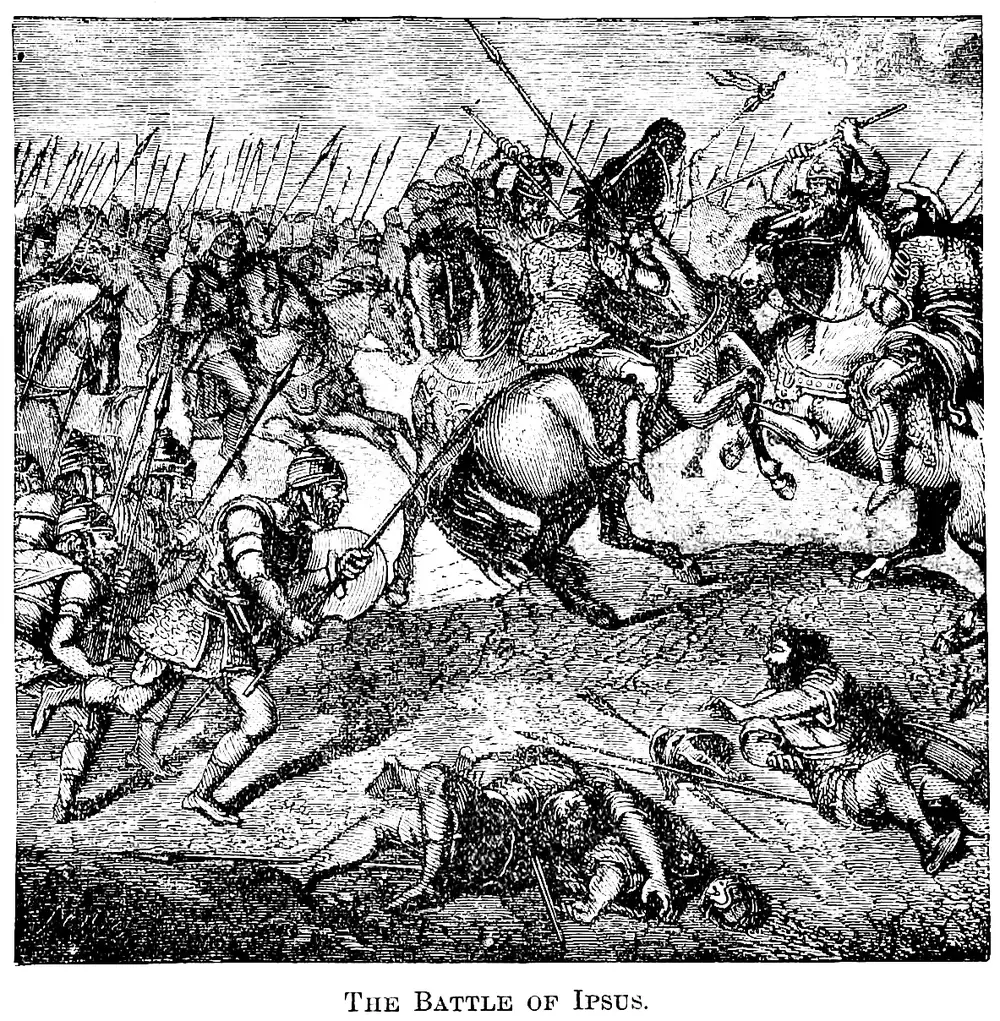
An old one-eyed man steps out of his tent and falls flat on his face. His phalanx is already forming; he has hurt himself badly, but he gets up and stretches out his hands towards heaven, praying that the gods grant him victory, or “a painless death before his defeat”.[1] His name is Antigonus, he is eighty-one, and he once served as one of Alexander the Great's generals.[2][3] The year is 301 BC, the place near Ipsus, in Phrygia.[3] By the end of the battle he is dead, and his victors carve up his kingdom “as if it had been a great carcass”.[1] Out of that division come the kingdoms that will fight over the Greek East until Rome arrives.
- 306 BCAntigonus makes himself kingThe strongest of Alexander's heirs takes the royal title; his rivals follow suit.
- 302 BCThe coalitionCassander, Lysimachus, Seleucus and Ptolemy join forces against him.
- 301 BCIpsusAntigonus is killed; his son Demetrius flees.
- c. 300 BCAntiochSeleucus founds his capital on the Orontes.
- 281 BCThe end of the heirsLysimachus falls at Corupedium, Seleucus is murdered.
- 168 BCThe circle of PopiliusRome stops the last war over Coele-Syria.
306 – 301 BC
One king against all the others
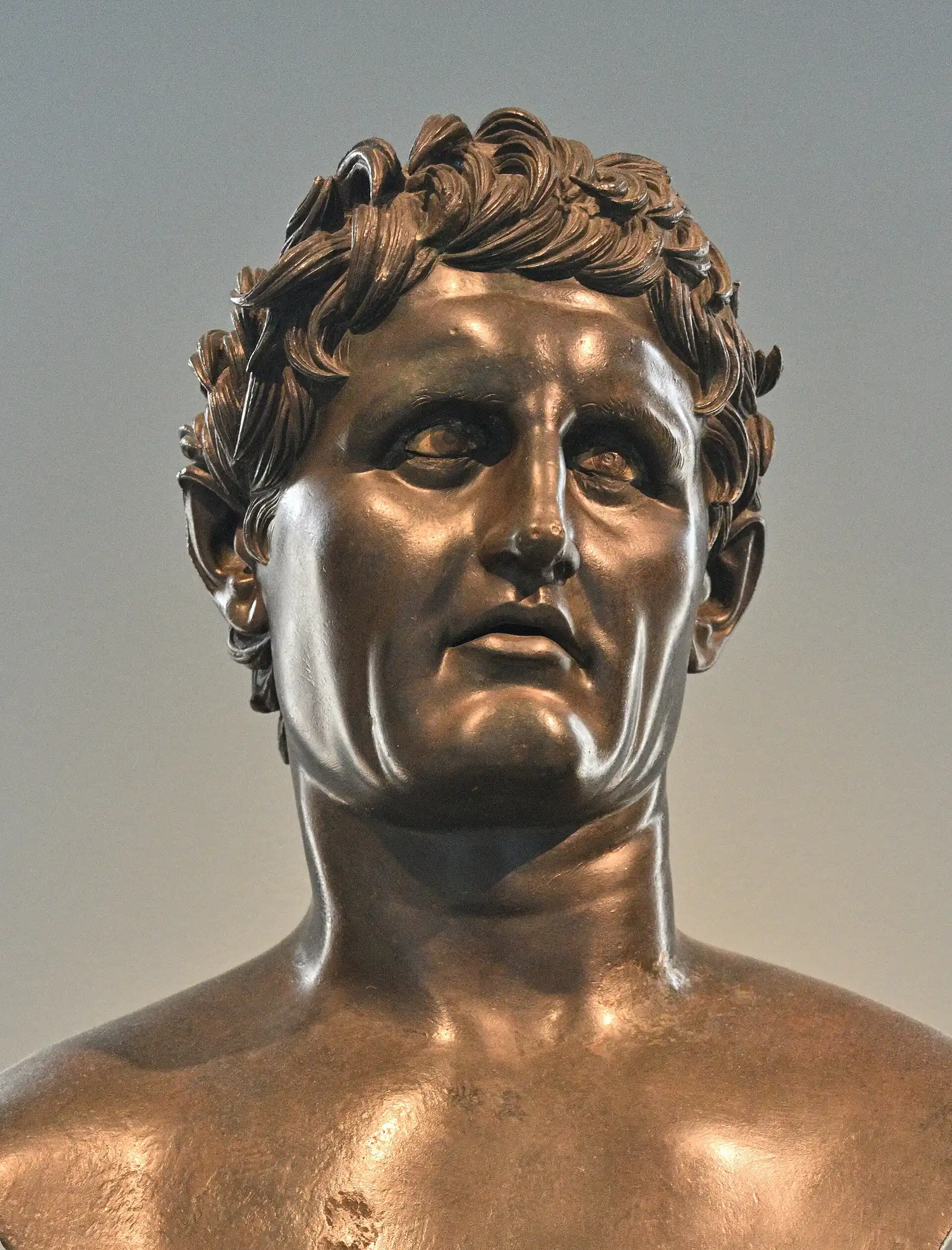
Since Alexander's death in 323, his generals have been fighting over his empire.[3] Antigonus, known as the One-Eyed, has become the strongest of them: master of Asia, he took the title of king around 306, and his rivals soon did the same.[4][5] His son Demetrius besieged Rhodes for a year with a siege tower “ten stories and 40 meters high”; it earned him his surname, Poliorcetes, “taker of cities”.[6]
Antigonus has a flaw that Plutarch thinks fatal. Had he made “some trifling concessions” and curbed his passion for dominion, he might have kept the supremacy and left it to his son. But he is stern and haughty, in word as in deed, and he turns young and powerful men against himself.[1] Their alliance, he says, he will scatter “with a single stone and a single shout, as if they were a flock of granivorous birds”.[1]
The coalition forms again around 302.[5] It brings together Cassander, king of Macedonia; Lysimachus, ruler of Thrace, who crosses into Asia Minor and takes Sardis and Ephesus; and Ptolemy, king of Egypt, who nonetheless stays out of the fighting.[3] Antigonus recalls Demetrius from Greece. The son obeys, makes a provisional agreement with Cassander and lands at Ephesus.[7] Cassander, for his part, sends his brother Pleistarchus with 12,000 foot and 500 horse to support Lysimachus.[7][1]
The decisive player comes from the east. Seleucus, governor of Babylon, driven out by Antigonus and then back again, has made himself master of the Iranian provinces.[4] In India he has come to terms with King Sandrocottus, the Chandragupta of Indian sources: he gave him lands conquered by Alexander in exchange for a marriage alliance and 500 elephants.[8][4] Justin puts it in one sentence: Seleucus, having settled his affairs in the east, sets off to join the war against Antigonus.[9] He reaches Cappadocia with about 20,000 foot, 12,000 horse including mounted archers, 480 elephants and more than a hundred scythed chariots, and goes into winter quarters there.[7]
The charge that never came back
When summer comes, as the kings had decided, the two armies face each other.[7] According to Plutarch, Antigonus fields more than 70,000 foot, 10,000 horse and 75 elephants; his opponents 64,000 foot, 500 more horse than he has, 400 elephants and 120 chariots.[1] The old king, usually loud and mocking before a fight, falls silent. He presents his son to the army as his successor and shuts himself up alone with him in his tent, something he never used to do.[1] Demetrius dreams that Alexander, in shining armour, asks him for the battle's watchword. “Zeus and Victory,” he replies. Then, says the ghost, “I will go away and join your adversaries; they surely will receive me.”[1]
Battle is joined. Demetrius, with “the largest and best part of the cavalry”, charges Antiochus, the son of Seleucus, and routs him.[1] But he pursues him too far. When he tries to return to his infantry, the enemy's elephants block his way.[1] A young prince of Epirus fights at his side: Pyrrhus, “though still a stripling”, routs the enemy facing him.[10] Elsewhere, Diodorus writes, the elephants of Antigonus and Lysimachus fight “as if nature had matched them equally in courage and strength”.[11]
Seleucus sees that Antigonus' phalanx no longer has cavalry to cover it. He does not charge it: he keeps his horsemen riding round it, threatening an attack, and gives it time to change sides. A large body of infantry comes over to him; the rest flee.[1] As the enemy bears down on Antigonus, one of his companions warns him: “They are making at thee, O King.” “Who else, pray,” said Antigonus, “should be their mark? But Demetrius will come to my aid.”[1] He watches for his son to the last. A cloud of javelins falls on him. His friends abandon him; only one stays by the body, Thorax of Larissa.[1]
Hieronymus of Cardia, the historian who served on the campaign with him, put his age at eighty-one.[2] Diodorus adds that Antigonus, pierced by many missiles, was carried from the field and buried with royal honours.[11] Demetrius flees without stopping as far as Ephesus, with 5,000 foot and 4,000 horse.[1]
A historians' debate: how reliable is the story of Ipsus?
It all rests on a few pages. The main account of the battle is Plutarch's; Appian gives the name of the place, Diodorus a few details, and all three seem to go back to Hieronymus of Cardia, who was on the campaign, according to Jona Lendering.[3][2]
The numbers are disputed. Lendering thinks Plutarch's figures “appear to be inflated”, but holds it “reasonably certain” that once Seleucus had arrived the two armies were roughly equal.[3] The elephants do not match from one source to the next: 500 received from the Indian king according to Strabo, 480 in winter quarters according to Diodorus, 400 on the battlefield according to Plutarch.[8][7][1]
Even Demetrius' flight comes in two versions. Plutarch takes him to Ephesus; Diodorus has him join his mother in Cilicia, where she was keeping their valuables, then sail to Salamis in Cyprus.[1][11] Diodorus also counts Ptolemy among the allied kings, whereas his modern editor points out that Ptolemy “had not, in fact, taken part in the battle”.[11]
301 BC
A great carcass
The victors add the provinces of the vanquished to their own.[1] Lysimachus receives western Anatolia; Pleistarchus, Cassander's brother, Cilicia and Lycia; Seleucus is to have Syria. Ariarathes II seizes Cappadocia.[3] For the French scholar Jean Delorme, Syria was the prize of victory for Seleucus.[4]
But when Seleucus reaches Phoenicia to take possession of Coele-Syria, the southern part of the country, Ptolemy has already occupied its cities. The king of Egypt complains that a friend has been given a region that belonged to him, and that he has received nothing of the conquered lands.[11][3] Seleucus replies that “those who were victorious on the battlefield should dispose of the spoils”. For friendship's sake he will not interfere for the present, but “would consider later how best to deal with friends who chose to encroach”.[11] This, Delorme sums up, became a source of endless wars.[4]
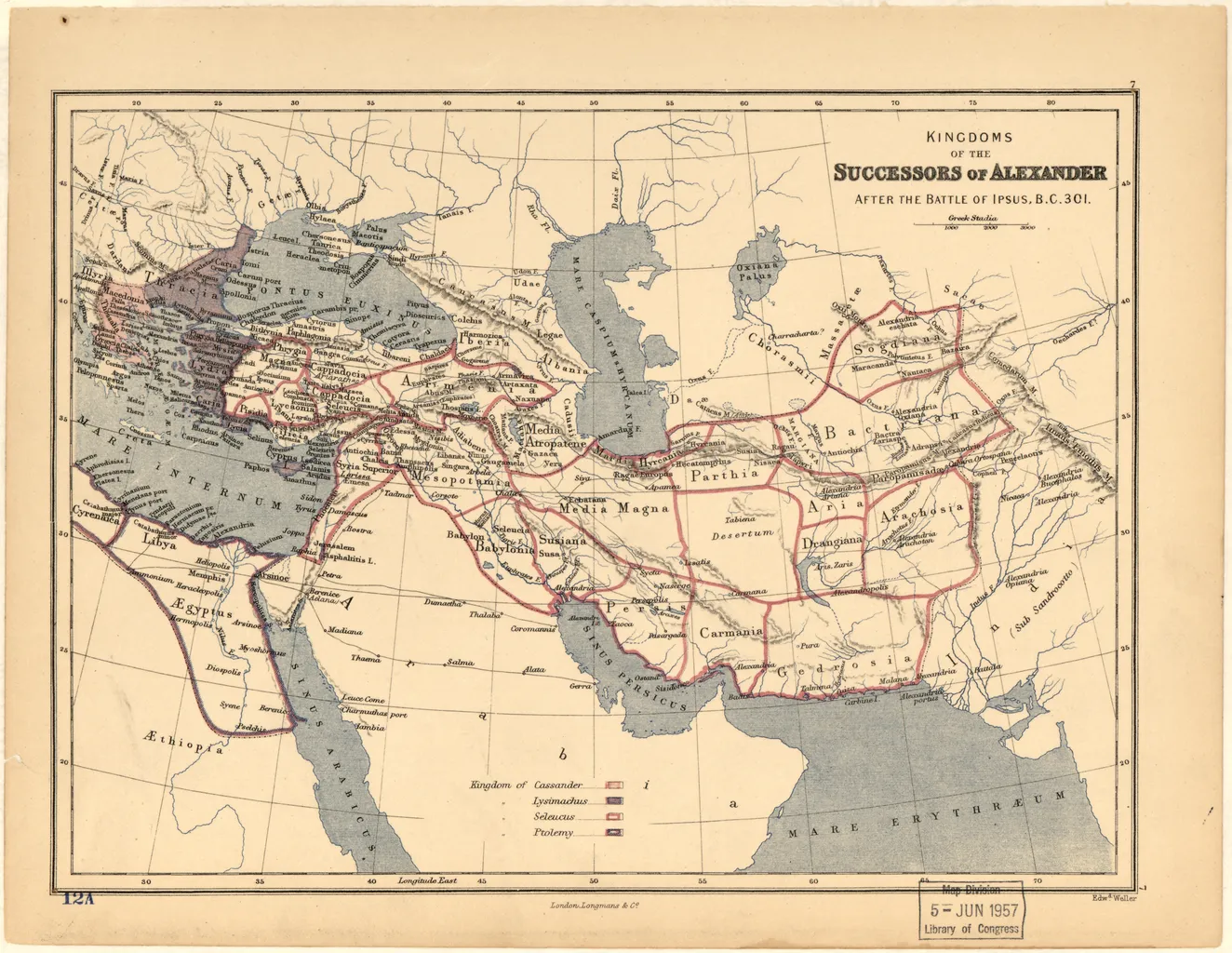
Ipsus did not break up Alexander's empire: for Lendering, Antigonus' attempt to reunite it had already failed in the Babylonian War of 311-309, and the battle “did nothing to change that”. What it did was end about twenty years of war.[3]
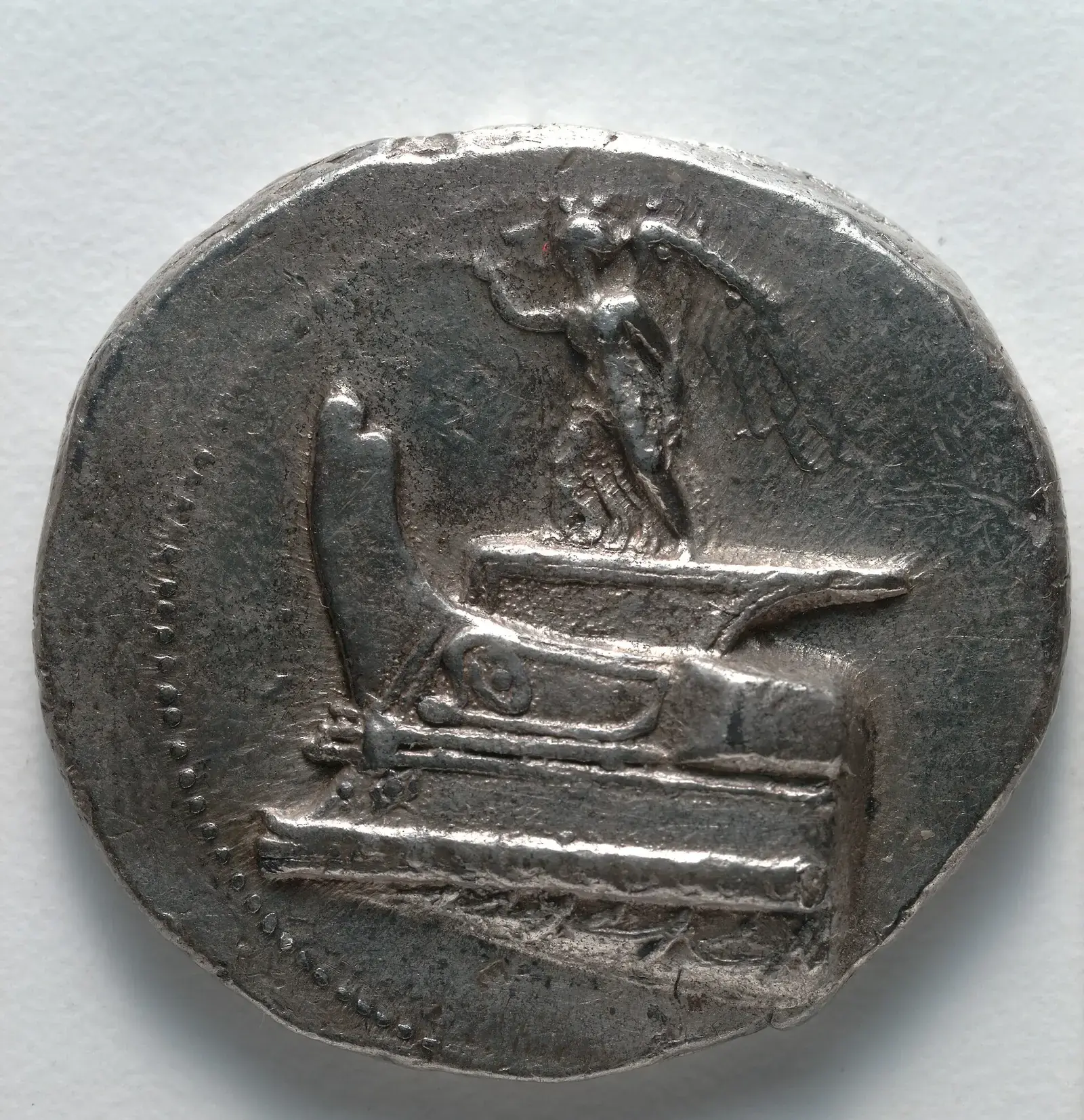
Why the last battle? For lack of money, he suggests. The coins indicate that the treasure Alexander had seized in the Persian capitals was running out, and Seleucus, who held it, was short of funds; that is also what kept him from attacking Ptolemy over Coele-Syria.[3] The metal of the Great Kings had paid for twenty years of war between Alexander's heirs.
301 – 281 BC
Yesterday's allies
Demetrius stakes everything on Athens, where he has left ships, money and his wife. Near the Cyclades an Athenian embassy meets him: the people have voted “to admit none of the kings”.[1] He, who had borne his other misfortunes calmly, flies into a rage. Plutarch draws the lesson: the least cogent proof of a people's goodwill is a lavish bestowal of honours, for fear can dictate them as easily as affection.[1]
The victors do not stay united for long. As they “could not agree about the spoil”, Justin writes, they split into two camps: Seleucus draws closer to Demetrius, Ptolemy to Lysimachus.[9] Lysimachus marries one of Ptolemy's daughters and gives another to his son; Seleucus in turn asks for the hand of Stratonice, Demetrius' daughter.[1] The two men meet at Rhosus, on the Syrian coast, and spend whole days together, “without guards or arms”, before Seleucus goes up in great state to Antioch with his new wife.[1]
The loser of Ipsus bounces back. The Macedonians, who hate Antipater, a son of Cassander who had killed his mother, proclaim Demetrius king.[1][9] Then the wheel turns again: around 286, Seleucus takes him prisoner.[4] Demetrius spends three years in captivity, takes to drinking and dice, falls ill and dies “in the fifty-fifth year of his life”.[1]
That leaves the duel between the two victors. In February 281, at Corupedium, in western Asia Minor, the army of Seleucus, aged seventy-seven, meets that of Lysimachus, aged eighty. Lysimachus is killed; it is “the last time that two former officers of the army of Alexander clashed”.[12] Seleucus marches west, but he is murdered by Ptolemy Keraunos, an exiled son of the king of Egypt.[12] Demetrius had died in 283, Ptolemy in 282, Lysimachus and Seleucus in 281: “The age of Alexander's Successors was over,” Lendering concludes.[12]
c. 300 BC
Four sisters on the Orontes
Seleucus also wipes out the traces of his rival. Antigonus had founded Antigonia on the Orontes; Seleucus tears it down and moves its people to the city he has founded, Diodorus says.[11] Strabo adds that these settlers from Antigonia populate the first quarter of Antioch, which Delorme dates to around 300.[13][4] With this capital, Seleucus turns towards the Mediterranean world and its conflicts.[4]
Antioch is not alone. In the same region Seleucus founds four cities that “used to be called sisters, because of their concord with one another”: Antioch, named after his father; Seleucia in Pieria, the best fortified, after himself; Apamea, after his wife Apama; Laodicea, after his mother.[13] At Apamea he keeps his 500 elephants and most of his army, as later kings would do too.[13]
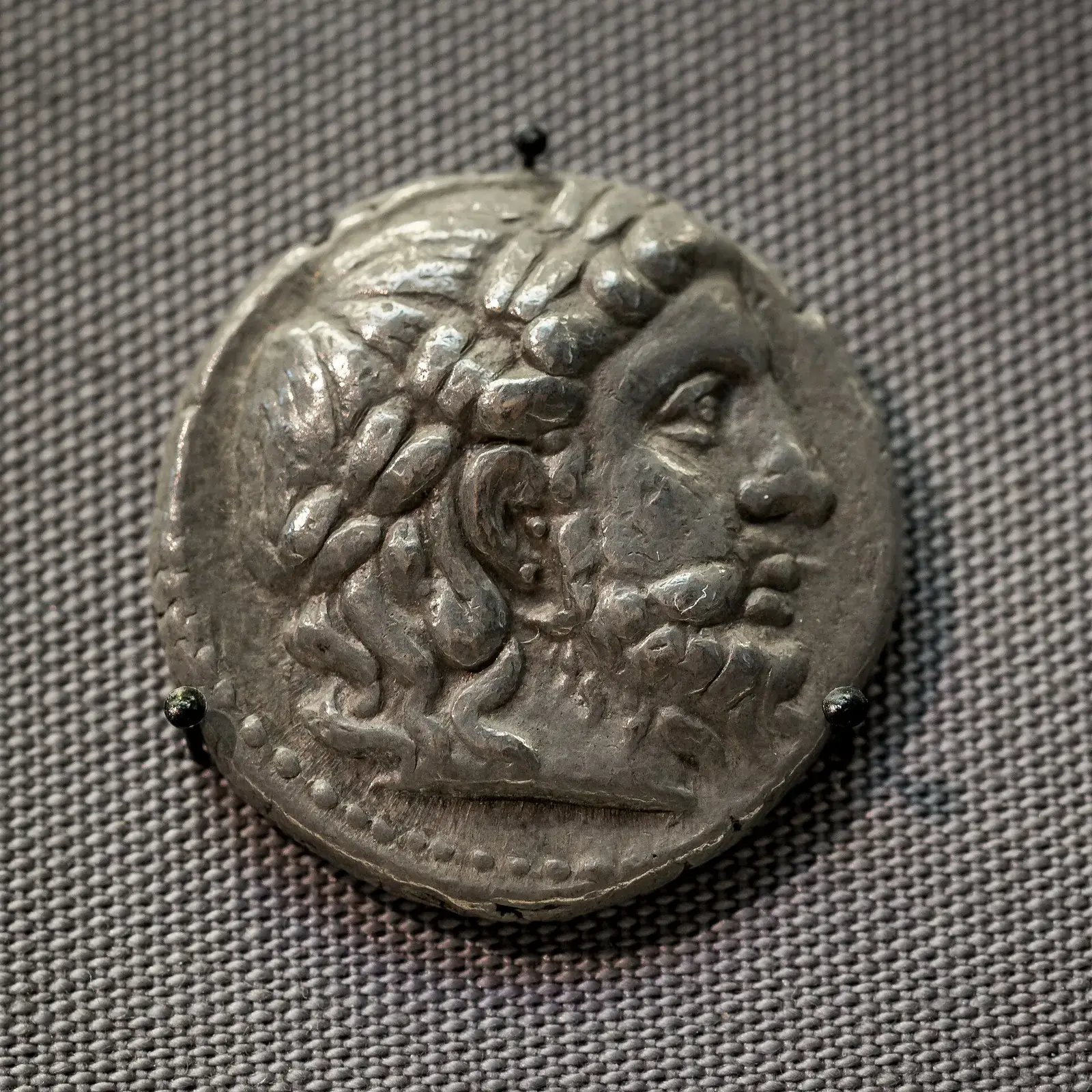
The kingdom he builds is vast and disparate. Organising it occupies Seleucus for a long time; he entrusts the government of the eastern provinces to his son Antiochus around 294 or 293.[4] In Lendering's words: “New kingdoms were created within the old one: Ptolemaic Egypt, the Seleucid Empire, and Macedonia.”[3]
301 – 168 BC
The case of Coele-Syria
The quarrel over Phoenicia does not die down. The Syrian Wars set the Seleucids against the Ptolemies through the third and second centuries BC; at stake was Coele-Syria, “more or less identical to modern Israel, the Palestine territories, Lebanon, and southern Syria”.[14]
Polybius preserves the record of a negotiation between a Seleucid king, Antiochus, and the envoys of a King Ptolemy, in which Ipsus is still being argued. Antiochus invokes the convention made by Antigonus' conquerors, “when all three of them, Cassander, Lysimachus, and Seleucus, after deliberating in common, decided that the whole of Syria should belong to Seleucus”.[15] The Egyptian envoys answer that Ptolemy had helped Seleucus on condition that he would “obtain Coele-Syria and Phoenicia for himself”. Each side repeats its arguments, and the talks get nowhere, for want of an arbiter strong enough to enforce what was just.[15]
The arbiter finally comes from the west. In 168 the Seleucid king Antiochus IV besieges Alexandria; a Roman embassy led by Gaius Popilius Laenas orders him to go home, and the Sixth Syrian War ends there.[14] Polybius tells the scene. Popilius hands the king the Senate's decree; Antiochus wants to consult his friends. With “a stick cut from a vine”, the Roman draws a circle round him and tells him to stay inside it until he has given his answer. After a moment's hesitation, the king agrees to everything.[16] Alexander's heirs had never found a judge for their partition; Rome took on the role.
The next link
At Ipsus, a young prince of Epirus had fought on the losing side and routed the men facing him.[10] Some twenty years later, called in by Tarentum, he would cross to Italy with elephants.[10] The next link takes us to the banks of a river in southern Italy, at Heraclea.
Further reading
- Dividing the Spoils: The War for Alexander the Great's Empire — Robin Waterfield (Oxford University Press, 2011)
A clear, lively narrative of the forty years of war between Alexander's successors, from Babylon to Corupedium.
- Antigonos the One-Eyed and the Creation of the Hellenistic State — Richard A. Billows (University of California Press, 1990)
The scholarly biography of the loser of Ipsus, and of the state he tried to build.
- Life of Demetrius — Plutarch, trans. Bernadotte Perrin (Loeb, 1920)
The only full account of the battle, and the main source of this article. Free to read online.
In the same series
Antiquity: the rise and fall of great empires · 3 of 10 articles published
Sources
- Plutarque, Vie de Démétrios, trad. anglaise B. Perrin, Loeb ; LacusCurtius
- Pseudo-Lucien, Les Longues Vies (Macrobii), trad. anglaise A. M. Harmon, Loeb ; attalus.org
- Jona Lendering, The battle of Ipsus, Livius.org
- Jean Delorme, Séleucos Ier Nicator (env. 356-281 av. J.-C.), Encyclopædia Universalis
- Jean Delorme, Antigonos Monophtalmos (env. 382-301 av. J.-C.), Encyclopædia Universalis
- Jona Lendering, Diadochi 8: The Fourth Diadoch War (2), Livius.org
- Diodore de Sicile, Bibliothèque historique, livre XX (chapitres 101-113), trad. anglaise R. M. Geer, Loeb ; LacusCurtius
- Strabon, Géographie, XV, 2, trad. anglaise H. L. Jones, Loeb ; LacusCurtius
- Justin, Abrégé des Histoires philippiques de Trogue Pompée, livre XV, trad. anglaise J. S. Watson, 1853
- Plutarque, Vie de Pyrrhus, trad. anglaise B. Perrin, Loeb ; LacusCurtius
- Diodore de Sicile, Bibliothèque historique, livre XXI (fragments), trad. anglaise F. R. Walton, Loeb ; LacusCurtius
- Jona Lendering, Corupedium (281 BCE), Livius.org
- Strabon, Géographie, XVI, 2, trad. anglaise H. L. Jones, Loeb ; LacusCurtius
- Jona Lendering, Sixth Syrian War (171-168), Livius.org
- Polybe, Histoires, livre V, trad. anglaise W. R. Paton, Loeb ; LacusCurtius
- Polybe, Histoires, livre XXIX, trad. anglaise W. R. Paton, Loeb ; LacusCurtius
This article was prepared with the help of artificial intelligence from verified sources, then reviewed, corrected and approved by the author. Our method.
It is a translation of the original French article.