Antiquity · event 6/10 · 216 BC
Battle of Cannae (216 BC): how Hannibal encircled a Roman army
On 2 August 216 BC, at Cannae, Hannibal surrounded and destroyed a Roman army. Rome refused to yield, went broke to hold on, and its defeat became a model.
 By Prism of the World
Listen to this article· 16 min · read by a synthetic voice (Google)
Contents
At daybreak, a scarlet tunic is run up above the Roman general's tent: the signal for battle.[1] That day the command belongs to the consul Varro; the two consuls take it in turns, a day each.[2] Just after sunrise he leads his troops out of both camps and draws them up facing south, on the bank of the Aufidus.[2] On the other side, a Carthaginian officer named Gisco is worried by their numbers. Hannibal answers him, Plutarch tells us, that “in all this multitude there is no one who is called Gisco”.[1] It is 2 August 216 BC by the Roman calendar, near the village of Cannae.[3] By evening Rome will have lost its army. It will not lose the war, but it will have to bankrupt itself to win it.
- 217 BCTrasimene and FabiusAfter two defeats, Rome hands the war to a delayer.
- 216 BCCannaeHannibal surrounds eight legions: tens of thousands of Romans die in a single day.
- 216-215 BCItaly comes apartCapua, part of the South and Macedonia side with Hannibal.
- 216-209 BCWar on creditSlaves enlisted, a doubled war tax, private gold: Rome ruins itself to hold on.
- 211 BCThe denariusA new silver coin is born in the middle of the crisis.
- 20th centuryThe Cannae modelSchlieffen makes Cannae the model of double envelopment; his book is translated for American officers.
217 – 2 August 216 BC
A crescent-shaped trap
For two years Hannibal has been beating the Romans in Italy. At the Trebia, only some ten thousand Roman foot break through and withdraw in good order. At Lake Trasimene “about fifteen thousand of the Romans” fall, and the consul Flaminius with them.[2] Rome then turns to a remedy “which for a long time had not been made use of or required”: it appoints a dictator, Quintus Fabius Maximus.[4] Fabius refuses battle; he means to wear Hannibal down, relying on the time, money and men Rome has to spare.[1] His soldiers mockingly call him “Hannibal's pedagogue”.[1]
The next year Rome changes course. The assembly elects two consuls, Lucius Aemilius Paullus and Gaius Terentius Varro.[2] The Senate decides “to bring eight legions into the field, a thing which had never been done before by the Romans”, each of about 5,000 men, not counting the allies.[2] Hannibal, for his part, seizes the citadel of Cannae, where the Romans had stored the corn and supplies of the district.[2]
The two armies camp by the Aufidus, today's Ofanto. Paullus does not want to fight on open ground against a superior cavalry; Varro does.[2] The soldiers often have to fight to get water.[4] Hannibal has pitched his camp with his back to the wind the locals call the Volturnus, which fills these dry plains with dust. On the day of battle it blows against the Romans and throws clouds of dust into their faces.[4][5]
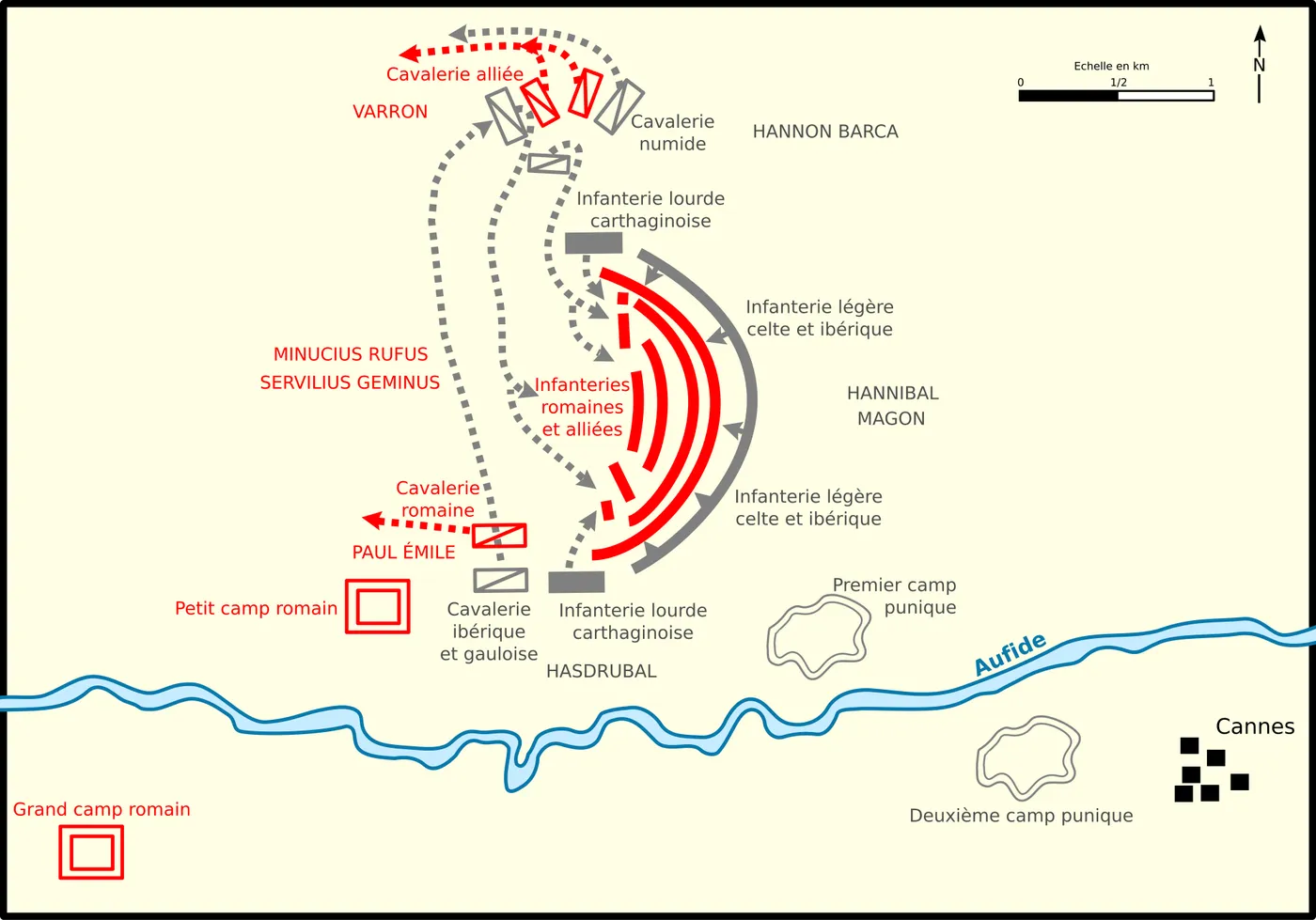
On 2 August Varro packs his maniples closer together, “making the depth of each many times exceed its front”.[2] Hannibal deploys differently. On his wings he places his Africans, armed in the Roman fashion with the best weapons taken from the defeated in earlier battles. In the centre he pushes forward his Spanish and Gallic infantry in a crescent, bulging towards the enemy.[2] Gauls and Spaniards alternate by companies, “the Gauls naked and the Spaniards in short tunics bordered with purple”.[2] Hasdrubal commands the cavalry on the left, by the river; Hannibal and his brother Mago hold the centre.[2]
Surrounded
The fighting opens with the horsemen, by the river. With no room to manoeuvre, “there were none of the normal wheeling evolutions”: the men dismount and fight hand to hand.[2] In the centre the Gauls and Spaniards hold for a while, then, “borne down by the weight of the legions”, they give way, breaking up the crescent. The Romans push into the gap.[2]
That is the trap. As they press forward, the Romans find the Africans on both their flanks. The Africans wheel and charge: the Roman infantry is caught between two walls, “as Hannibal had designed”, writes Polybius.[2] Livy describes the Carthaginian line turning “concave and crescent-shaped, the Africans at either end forming the horns”.[4] Hasdrubal, having destroyed the Roman cavalry by the river, drives off the allied horse, then throws his squadrons against the rear of the legions.[2] The Romans hold as long as they can face every side. Then, as the outer ranks fall, “they finally all were killed where they stood”.[2]
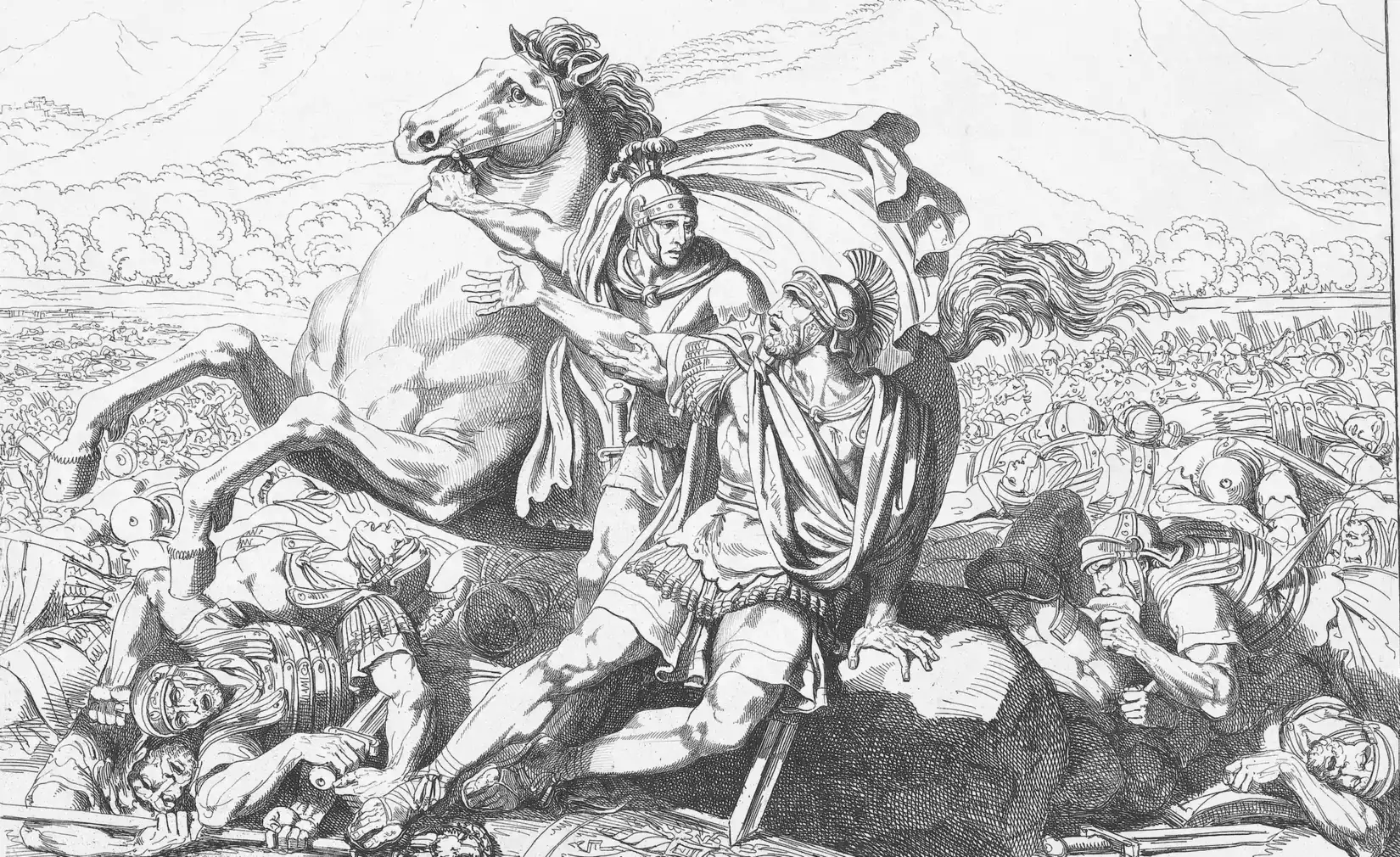
Paullus, wounded at the very start by a sling-stone, has fallen in the thick of the fighting.[2] Livy tells of his end. A young tribune, Lentulus, finds him covered in blood, sitting on a stone, and offers him his horse. The consul refuses and gives him a message: the Senate must “fortify Rome and make its defence strong before the victorious enemy approaches”, and Fabius must be told that he “ever remembered his precepts in life and in death”.[4] Varro escapes to Venusia with about fifty horsemen, seventy according to Polybius.[4][2]
The next day, Livy goes on, the victors walk the battlefield. A Numidian is found alive beneath a dead Roman, who had torn off his nose and ears with his teeth.[4] Hannibal leaves the plunder of the camps to his soldiers, “with the exception of the horses and prisoners and whatever silver there might be”.[4]
How many men, and where?
The numbers. Polybius gives the Romans “about eighty thousand foot and rather more than six thousand horse”, allies included; Hannibal about 10,000 horse and not much more than 40,000 foot.[2] Some of Livy's sources count 87,200 men in the Roman camp.[4] Hans Delbrück, followed by Schlieffen, counts 79,000.[6]
The dead. For Polybius about 70,000 Romans are killed, and Hannibal loses 5,700 men, mostly Gauls.[2] Livy counts 45,500 foot and 2,700 horse killed, Romans and allies in almost equal proportion, and as many as 8,000 dead on Hannibal's side.[4] Appian and Plutarch give 50,000 Roman dead; Schlieffen, 48,000.[7][1][6]
The date. 2 August comes from the annalist Claudius Quadrigarius, quoted by Aulus Gellius and by Macrobius.[3][8] It is a date in the Roman calendar, which did not keep in step with the solar year. For 217, the gap is put at two weeks at most by Paul Brind'Amour, at five or six by Peter Derow and Michael Fronda, and at three or four by Franz Miltner.[9]
The place. As early as 1912 Johannes Kromayer identified three schools of thought: the left bank of the Aufidus, the right bank upstream of Cannae, or the right bank downstream, which he favoured.[10] The Italian Ministry of Culture notes that “no archaeological documentation has yet been found regarding the battle of 216”.[11]
August 216 BC
You know how to win, Hannibal
That same evening the commander of the Carthaginian cavalry, Maharbal, urges Hannibal to march on Rome: “in five days you will be feasting as victor in the Capitol”. Hannibal hesitates. Maharbal then tells him that he knows how to win a victory, but not how to use one.[4][5] Plutarch gives the same retort to a man called Barca, “Thou canst win a victory, but thy victory thou canst not use”, and finds it hard to say what held Hannibal back.[1] According to a tradition preserved by Zonaras, the Carthaginian regretted it all his life, “ever crying out: ‘O Cannae! Cannae!’”[12]
In Rome the panic is immense. Livy, a patriot, writes: “Certainly there is no other nation that would not have succumbed beneath such a weight of calamity.”[4] Mourning is so general that the festival of Ceres is suspended; the Senate limits mourning to thirty days.[4] Hannibal offers to return the prisoners for a ransom and sends an envoy, Carthalo, to sound out the Senate about peace. A lictor orders him “to quit the territory of Rome before night”.[4]
Rome even refuses to buy back its captured soldiers. According to Polybius, it will neither hand money to Hannibal nor let its soldiers believe that a defeat can end with a ransom; he sees in this proof of the strength of the Roman constitution.[13] No one in Rome says the word “Peace”. And when Varro returns, a crowd of every rank goes out to meet him, and he is formally thanked because he “had not despaired of the republic”.[4]
A historians' debate: why didn't Hannibal march on Rome?
The ancients made it a flaw of character, through Maharbal's words.[4] Modern historians look elsewhere. Dexter Hoyos devotes a digression to why Hannibal marched on Rome neither after Trasimene nor after Cannae.[14] For him, Hannibal's fatal problem was “his inability to protect those Italian cities that joined him”.[15] Robert Garland suggests that Hannibal's “overall grasp of strategy may have been weak”, which would explain his failure to follow up the victory; his reviewer finds the point “probably” correct.[16]
216 – 215 BC
Gold rings in Carthage
Italy comes apart. Livy lists the peoples who go over to Hannibal: “the Atellani, the Calatini, the Hirpini, a section of the Apulians”, almost all the Samnites, the Bruttii, the Lucanians, much of the Greek coast.[4] Capua, the largest city in Italy after Rome according to Plutarch, changes sides. Its treaty with Hannibal guarantees its magistrates and laws, and exempts its citizens from serving against their will.[17][1] “Before the battle,” Plutarch notes, “he had not a city, not a trading-place, not a sea-port in Italy”; afterwards he brings almost all of Italy under his sway.[1]
Hannibal's brother Mago goes to announce the victory in Carthage. Before the Carthaginian senate he has a heap of gold rings, taken from the Roman dead, poured out. Some writers, Livy reports, speak of more than three and a half measures; the version he thinks closer to the truth says no more than one.[18] Only the knights, Mago explains, “and amongst them only the highest in rank, wore that ornament”.[17] Yet an old senator, Hanno, asks two questions: has any single Latin community come over? Has “a single man out of the thirty-five Roman tribes” deserted to Hannibal? “Mago answered both questions in the negative.”[17]
The Greek world, meanwhile, picks its side. After Hannibal's third victory, King Philip V of Macedon sends ambassadors to make an alliance.[17] Polybius has preserved the text of the treaty sworn between Hannibal and the king's envoy.[19] In Syracuse the young king Hieronymus also allies himself with Carthage; as the Roman envoys leave, he asks them in jest “what fortune they had met with in the battle of Cannae”.[20]
216 – 204 BC
War on credit
To replace its dead, Rome scrapes the barrel. It enrols everyone from seventeen upwards, “some even younger”, and forms four legions and 1,000 horse; the arms taken from old enemies are taken down from the temples.[4] For want of free men, the state buys and arms 8,000 “sturdy youths from amongst the slaves”, after asking each whether he was willing to serve.[4] The dictator also frees 6,000 condemned men and debtors who agree to enlist, and arms them with Gallic spoils carried in an earlier triumph.[17] In its panic Rome even performs an exceptional rite: on the orders of the Sibylline Books, “a Gaulish man and a Gaulish woman and a Greek man and a Greek woman were buried alive” in the Forum Boarium. Livy judges the practice alien to Roman feeling.[4]
Then comes the money. The treasury can no longer pay the soldiers and sailors in Sicily and Sardinia; it is King Hiero of Syracuse who supplies money and corn.[17] In Rome itself, “the scarcity of money was felt”, and three finance commissioners are appointed.[17] In 215 the Senate doubles the war tax. It notes that the tax has shrunk “with the number of those who paid it after the destruction of the armies at Trasumennus and at Cannae”: without credit, the state cannot hold out.[17] Three companies of contractors agree to equip the army in Spain on credit; “the administration of the State,” writes Livy, “was carried on with private money”.[17]
The same year, a law, the lex Oppia, forbids any woman “to have in her possession more than half an ounce of gold” or to wear a dress of various colours.[20] The treasury is so empty that the censors give up letting out public works. The funds of orphans and widows are deposited in the treasury; horsemen and centurions refuse their pay, and anyone who accepts it is called “mercenary”.[20] In 210 the senators bring their gold, silver and bronze to the treasury, keeping only their rings.[20] In 209 Rome finally draws on its secret gold reserve, “kept as a reserve for extreme emergencies”: “Four thousand pounds of gold were produced.”[20]
The coinage itself changes. According to the numismatist Michael Crawford, the weight of the bronze as was cut from the end of 216, and bronze, which paid the army, was “the most important factor in the financial crisis of the Second Punic War”.[21] A new silver coin is born in the turmoil: the denarius. Crawford dates its introduction to between 213 and 211, thanks to the excavations at Morgantina in Sicily; the American Numismatic Society's catalogue dates the first type to 211.[21][22] Pliny the Elder placed the first Roman silver coinage much earlier, in 269, and said that “when Hannibal was pressing hard upon Rome”, asses of one ounce were struck.[23]
The survivors of Cannae pay for everyone. The Senate sends them to serve in Sicily for as long as the war lasts in Italy, without discharge or reward.[17][20] Rome changes strategy: “the Romans called Fabius their buckler, and Marcellus their sword”, Plutarch reports after Poseidonius.[1] In 204 Scipio takes these soldiers to Africa: they form his fifth and sixth legions, and he knows “that the defeat at Cannae was not brought about by any cowardice on their part”.[20] Polybius draws the lesson: “by the peculiar virtues of their constitution and by wise counsel”, the Romans recovered Italy, defeated Carthage and soon became masters of the world.[2]
20th century
The model of encirclement
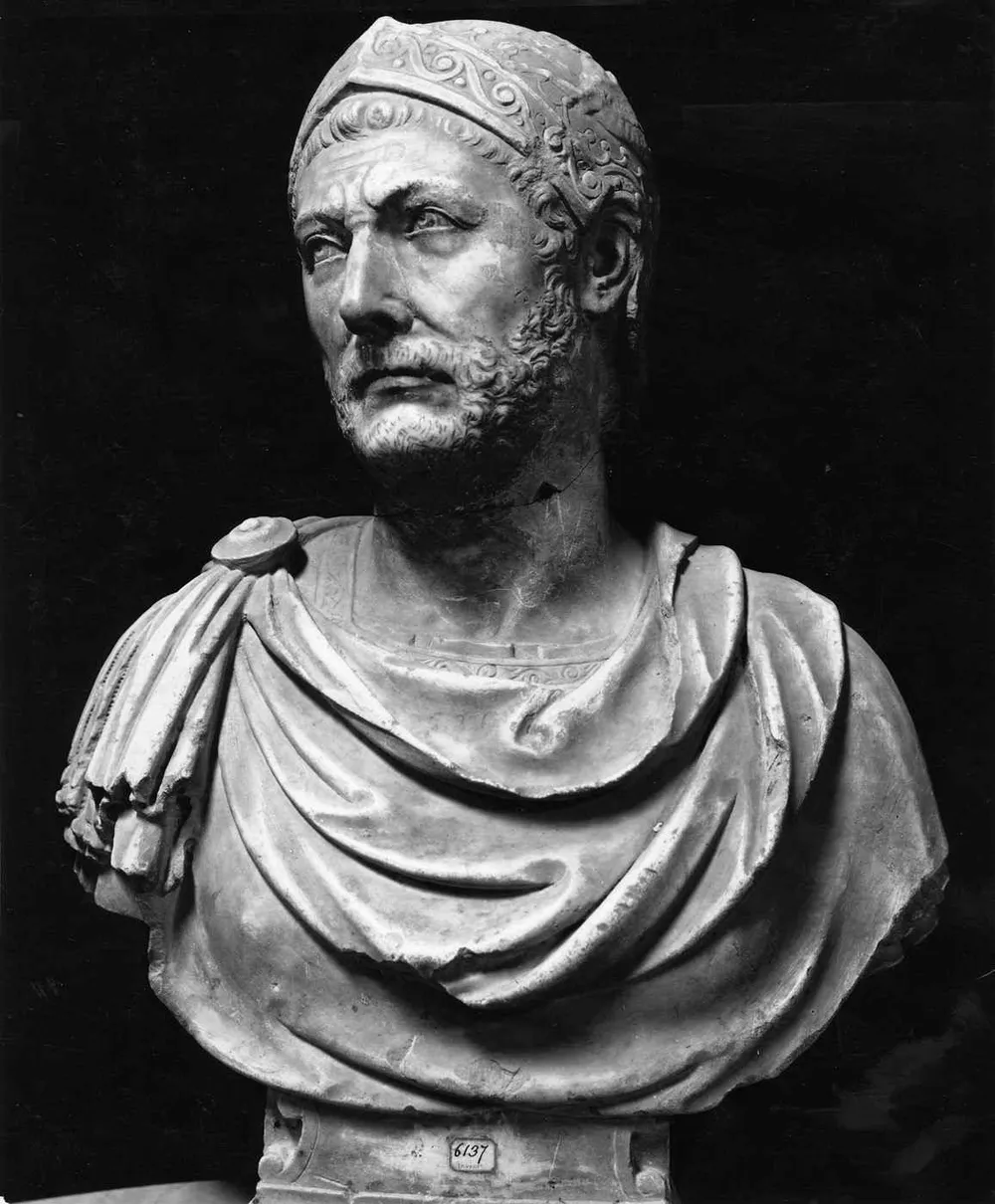
Polybius had already drawn a lesson from Cannae for posterity: “it is better to give battle with half as many infantry as the enemy and an overwhelming force of cavalry than to be in all respects his equal”.[2] Two thousand years later the battle becomes a model. In the early twentieth century the chief of the German General Staff, Alfred von Schlieffen, thinks he has found in the historian Hans Delbrück's account of Cannae the key to beating a more numerous enemy. He has the historical section of the General Staff produce a set of “Cannae Studies” on double envelopment.[6]
For him Cannae is “a battle of complete extermination”, won by an army inferior in numbers that enveloped both wings and even the rear of the enemy.[6] He adds: “A complete battle of Cannae is rarely met in history. For its achievement, a Hannibal is needed on the one side, and a Terentius Varro, on the other.”[6] The historian Christopher Bassford confirms that Delbrück's analysis had “an important influence” on Schlieffen. But he also cites Jehuda Wallach, for whom “Schlieffen's understanding of Delbrück's analysis was incomplete, and the basis for his strategic concept had been laid before he read of Cannae”.[24] Cannae was a model Schlieffen claimed, more than a cause.
The title itself shows the place of antiquity in the military culture of the time. According to Jorit Wintjes, Schlieffen published his ideas under the title “Cannae” even though the battle made up “only a very minor part of his study”, which dealt mainly with the wars of 1866 and 1870.[25] The American staff school at Fort Leavenworth published a translation for its officers in 1931, and reprinted it in 1992. Its 1992 preface took care to point out that Cannae “still did not produce a strategic success, even though it was a tactical masterpiece. Hannibal lost the war with Rome.”[6]
The next link
Rome survived Cannae and defeated Carthage. Two centuries later no foreign enemy threatens it anywhere in the Mediterranean: its own generals fight over its empire, all the way to the sea battle of Actium.
Further reading
- Cannae: The Experience of Battle in the Second Punic War — Gregory Daly (Routledge, 2002)
A close study of the two armies, their commanders and what the men who fought actually went through.
- The Ghosts of Cannae: Hannibal and the Darkest Hour of the Roman Republic — Robert L. O'Connell (Random House, 2010)
A readable history of the battle, the survivors sent to Sicily, and the legend Cannae left to later soldiers.
- The Histories, Book III — Polybius, trans. W. R. Paton (Loeb)
The earliest surviving account of the battle, and the main source of this article. Free to read online.
In the same series
Antiquity: the rise and fall of great empires · 3 of 10 articles published
Sources
- Plutarque, Vie de Fabius Maximus, trad. anglaise B. Perrin, Loeb ; LacusCurtius
- Polybe, Histoires, livre III, trad. anglaise W. R. Paton, Loeb ; LacusCurtius
- Aulu-Gelle, Nuits attiques, V, 17, trad. anglaise J. C. Rolfe, Loeb ; LacusCurtius
- Tite-Live, Histoire romaine, livre XXII, trad. anglaise C. Roberts ; Perseus (chapitres 8 à 61)
- Tite-Live, Ab Urbe condita, livre XXII (texte latin), The Latin Library
- Alfred von Schlieffen, Cannae, traduction autorisée, Fort Leavenworth, Command and General Staff School Press, 1931 ; réimpression 1992 ; Internet Archive
- Appien, La guerre d'Hannibal, 21-25, trad. anglaise H. White, 1899 ; Livius.org
- Macrobe, Saturnales, I, 16 (texte latin), LacusCurtius
- C. F. Konrad, Das Datum der Schlacht am Trasumenischen See, Rheinisches Museum für Philologie, 166, 2023
- Johannes Kromayer, Antike Schlachtfelder, III, 1 : Italien, Berlin, Weidmann, 1912 ; Internet Archive
- Ministère italien de la Culture, musées des Pouilles, Antiquarium and Archaeological Park of Canne della Battaglia
- Dion Cassius et Zonaras, Histoire romaine, livre XV ; Zonaras, IX, 1, trad. anglaise E. Cary, Loeb ; LacusCurtius
- Polybe, Histoires, livre VI, trad. anglaise W. R. Paton, Loeb ; LacusCurtius
- Paul Burton, Compte rendu de D. Hoyos, Hannibal's Dynasty (2003), Bryn Mawr Classical Review, 2005.07.65
- Fred K. Drogula, Compte rendu de D. Hoyos, Mastering the West (2015), Bryn Mawr Classical Review, 2015.09.40
- Fred K. Drogula, Compte rendu de R. Garland, Hannibal (2010), Bryn Mawr Classical Review, 2010.09.48
- Tite-Live, Histoire romaine, livre XXIII, trad. anglaise C. Roberts ; Perseus
- Tite-Live, Ab Urbe condita, livre XXIII (texte latin), The Latin Library
- Polybe, Histoires, livre VII, trad. anglaise W. R. Paton, Loeb ; LacusCurtius
- Tite-Live, Histoire romaine, livres XXIV à XXXIV, trad. anglaise C. Roberts ; Perseus
- M. H. Crawford, War and Finance, Journal of Roman Studies, 54, 1964, p. 29-32
- American Numismatic Society, Coinage of the Roman Republic Online, RRC 44/5
- Pline l'Ancien, Histoire naturelle, XXXIII, 13, trad. anglaise J. Bostock et H. T. Riley, 1855 ; Perseus
- Christopher Bassford, Clausewitz in English, chapitre 19, Oxford University Press, 1994
- Jorit Wintjes, Compte rendu de R. Konijnendijk, Between Miltiades and Moltke, Bryn Mawr Classical Review, 2024.04.17
This article was prepared with the help of artificial intelligence from verified sources, then reviewed, corrected and approved by the author. Our method.
It is a translation of the original French article.